



Health & Education
We all want the best care possible for our horses. The Heath & Education section covers both Learning Institutions, Organizations as well as many sources for equine assistance including Veterinarians and Farriers.
For those who want a to formally study horses, the Education section includes College Riding, Equine Studies, and Veterinary Schools. Learn about the wide variety of horses in the Horse Breeds section. Supplements and Treatments Therapy are also included in the section.
Everyone can learn from Fine Art and there are some specialty Museums that might surprise you.
Horses as a therapy partner enrich the lives of the disabled. These facilities are listed in our Therapeutic Riding section. To help children and young adults build confidence and grow emotionally, please see the resources available on the Youth Outreach page.
Looking for a place to keep your horse? You can find it in the Horse Boarding section. Traveling? Find a Shipping company or Horse Sitting service if your horse is staying home!
Want to stay up to date with the latest training clinics or professional conferences? Take a look at our Calendar of Events for Health & Education for the dates and locations of upcoming events.
Do we need to add more? Please use the useful feedback link and let us know!
by Capt. William E. Simpson II - USMM Ret.
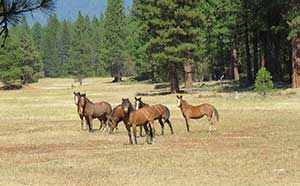
In the latest cooperative effort with a handful of visionary politicians, natural resource advocates and supported by noted wildlife biologist Craig C. Downer, rancher-author William E. Simpson II has opened a new line of communication with Siskiyou County, CA.
Here is an open letter by Craig C. Downer, Wildlife Biologist, followed by a response from Capt. Simpson.
"The pilot test of the Wild Horse Fire Brigade as proposed by Mr. Simpson is both ecologically and economically sound and solidly positioned upon well-established science [1]. Cultural and paleontological evidence from the locale shows that wild horses lived in the area of the Soda Mountain Wilderness area of Southern Oregon and Northern California for millennia and up until recent times.
"I spent 3-days on-site touring the landscape on foot and have evaluated the conditions of the local flora and fauna. From my findings, I concur with Mr. Simpson that there is a severe depletion of large-bodied native herbivores here.
This situation has led to super- abundant vegetation to become intensively established throughout the landscape, a major portion of which is rocky and of rugged, accentuated topography. At present, the wild horses here are well below their carrying capacity for this particular ecosystem, and this ecosystem could greatly benefit from their increase.
Other native herbivores have been and continue to be depleted by a robust population of lions and coyotes. The predated remains of adult and sub-adult wild horses are frequently encountered in this reserve along with scant remains of deer. I concur with Mr. Simpson that the use of livestock for fuel abatement would result in significant loss of animals and financial investment.
![A German Trakehner horse named SongLine relaxes as his acupuncture needles work at the new UF Equine Acupuncture facility. [Alan Youngblood/Staff photographer]](/images/stories/acupuncture/acupuncture003intro.jpg)
by Carlos E. Medina
The new University of Florida Equine Acupuncture Center in northwest Marion County will focus on treatment, education and research of the ancient healing art.
Dr. Huisheng Xie grew up in a family of Chinese herbalists who prescribed custom mixtures of herbs and plants to treat any number of human maladies. But he decided to apply the ancient practice of traditional Chinese medicine to the veterinary field, particularly to horses.
After 35 years practicing acupuncture and refining herbal medicines for animals, the doctor of veterinary medicine and a clinical professor of integrative medicine with the UF Department of Comparative, Diagnostic & Population Medicine, is celebrating the newly opened University of Florida Equine Acupuncture Center in northwest Marion County.
The center, a partnership between Xie and the UF College of Veterinary Medicine, includes a 6,240-square-foot barn with an attached 12,500-square-foot arena. It is located between Irvine and Flemington, on County Road 318.
For Xie, the growing acceptance of traditional Chinese medicine by the West is in stark contrast to what he faced when he started as a professor at the university in 1998.
"When I first started the job at the University of Florida, people talked about acupuncture like it was a joke. Now, over 90 percent of the faculty accepts it and refers cases to us," Xie said.
In the 20 years since he started with the university, a growing number of studies and continued research back the anecdotal benefits of acupuncture.
- Equine Connection: International Horse Certification Course with Business Training
- Care of the Mare and Foal at Weaning
- Dental Basics: The Who, What, When, How and Why of Floating Teeth
- How Myofascial Bodywork Helps Horses
- The Effects of Routine Morning Exercise on Muscle Response
- Is the Great British Shire Horse About to Go Extinct?
- Red Light at Night Facilitates Recovery and Rest
- Breathing Easy: A Key to Equine Health and Performance
- Alfalfa and the Insulin Resistant Horse - The True Story
- Burning And Learning?
- The Canadian Horse: Discover a Versatile Breed Rich in History
- Core Equine Disease Risks Increase Amid Mosquito Season
- Equilume Stable Light Can Influence Body Composition and Biological Rhythms in Horses-in-training
- Inflammation: It’s Not Just In Joints
- Horsepower: How Digital Technology is Transforming the Equine World
- Exercising and Training Horses in Hot Weather
- Choose Hemp Instead of Soy for Your Horse!
- Equine Odontoclastic Tooth Resorption and Hypercementosis
- What is the Ideal Conditioning Program for an Eventer?
- Is Your Horse a Slave in a Sand Box?