




Health & Education
We all want the best care possible for our horses. The Heath & Education section covers both Learning Institutions, Organizations as well as many sources for equine assistance including Veterinarians and Farriers.
For those who want a to formally study horses, the Education section includes College Riding, Equine Studies, and Veterinary Schools. Learn about the wide variety of horses in the Horse Breeds section. Supplements and Treatments Therapy are also included in the section.
Everyone can learn from Fine Art and there are some specialty Museums that might surprise you.
Horses as a therapy partner enrich the lives of the disabled. These facilities are listed in our Therapeutic Riding section. To help children and young adults build confidence and grow emotionally, please see the resources available on the Youth Outreach page.
Looking for a place to keep your horse? You can find it in the Horse Boarding section. Traveling? Find a Shipping company or Horse Sitting service if your horse is staying home!
Want to stay up to date with the latest training clinics or professional conferences? Take a look at our Calendar of Events for Health & Education for the dates and locations of upcoming events.
Do we need to add more? Please use the useful feedback link and let us know!
by Liz Forster
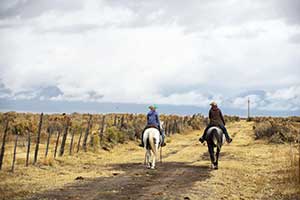
On a late autumn day in the San Luis Valley, rancher Julie Sullivan strolled through her meadow past hundreds of piles of raked hay. Her foreman Hana Fancher and apprentice Morgan Atkinson followed, engrossed in talk about the robust lower chests on their cattle, a sign of health.
Meanwhile, some 80 of the shaggy black bovines edged quietly toward the women, as if they were curious and needed a closer peek at the two-legged creatures wandering the fields.
The preoccupied women seemed to take little notice until they were suddenly encircled by their wide-eyed cattle. Some cows were bold enough to sniff a back pocket or an outstretched hand. The shy ones hung behind.
At many ranches and certainly at commercial feedlots such a scene would seem unlikely, cows congregating around their ranchers.
But at the 4,000-acre San Juan Ranch near Saguache, the lines are intentionally blurred. Here, the practice of humane animal handling requires an affinity with the animals. It is an approach and strength that Sullivan believes women are uniquely equipped to bring to ranching.
“We raise young women to be relational, to be more conscious of other people’s needs and concerns,” she said. “Young men often think they have to prove themselves and cowboy up. We don’t cowboy up around here, so we get cattle that follow us around.”

by Susan Kauffmann and Christina Cline
More and more horse owners are choosing to maintain their horses without shoes these days, for various reasons. Some are attracted by the fact that it is less expensive, others are comforted knowing they will never lose another shoe, and some feel safer with the increased surefootedness of a barefoot horse. But for most, the main reason to “go bare” is that they believe there are substantial health benefits, not just for the hooves, but for the entire horse.
Many experts agree about “going bare”…. Even Dr. Stephen O’Grady, a leading equine podiatrist who in the past was not seen as being particularly “barefoot friendly,” has actually published an article in the American Farrier’s Journal in which he states, “The equine foot with healthy structures is superior in its natural or barefoot state as opposed to the shod state with regards to accepting the weight of the horse, shock absorption and dissipating the energy of impact.”
There is still a perception among many in the horse world that barefoot only works if you don’t actually do much with your horse. Nothing could be further from the truth, as witnessed by the continually growing number of riders in disciplines ranging from endurance to eventing, from Western performance to dressage, at levels from pleasure riders to Olympic competitors, who are discovering that not only can their horses do what they do barefoot, they can do it better, and they are sounder than ever.
- Horse Health: Microchipping a Superior Form of Identification
- New Coat Colour in the Icelandic Horse
- Foal Q & A with Rood & Riddle’s Dr. Laurie Metcalfe
- The Equilume Light Masks Helps Pregnant Mares Foal on Time with Optimum Birth Weights
- Working with Horses to Develop Skills - Five Reasons Why It Works!
- Possible Link Between Selenium and Cribbing in Horses
- Lighting For Breeding and Performance
- Rider Biomechanics: Using Sensors to See How the Rider Influences the Horse (7:24)
- The Art of Seeing Lameness
- Wild Horses Can Re-balance The Ecosystem: Good For Outdoor Sports; Reduces Wildfires & Toxic Smoke
- Getting to the Point: Equine Acupuncture
- Equine Connection: International Horse Certification Course with Business Training
- Care of the Mare and Foal at Weaning
- Dental Basics: The Who, What, When, How and Why of Floating Teeth
- How Myofascial Bodywork Helps Horses
- The Effects of Routine Morning Exercise on Muscle Response
- Is the Great British Shire Horse About to Go Extinct?
- Red Light at Night Facilitates Recovery and Rest
- Breathing Easy: A Key to Equine Health and Performance
- Alfalfa and the Insulin Resistant Horse - The True Story