





Health & Education
We all want the best care possible for our horses. The Heath & Education section covers both Learning Institutions, Organizations as well as many sources for equine assistance including Veterinarians and Farriers.
For those who want a to formally study horses, the Education section includes College Riding, Equine Studies, and Veterinary Schools. Learn about the wide variety of horses in the Horse Breeds section. Supplements and Treatments Therapy are also included in the section.
Everyone can learn from Fine Art and there are some specialty Museums that might surprise you.
Horses as a therapy partner enrich the lives of the disabled. These facilities are listed in our Therapeutic Riding section. To help children and young adults build confidence and grow emotionally, please see the resources available on the Youth Outreach page.
Looking for a place to keep your horse? You can find it in the Horse Boarding section. Traveling? Find a Shipping company or Horse Sitting service if your horse is staying home!
Want to stay up to date with the latest training clinics or professional conferences? Take a look at our Calendar of Events for Health & Education for the dates and locations of upcoming events.
Do we need to add more? Please use the useful feedback link and let us know!

by Juliet M. Getty, Ph.D.
Your horse has an ulcer? “Give him omeprazole.”
Your horse is traveling on a long trip? “Give him omeprazole.”
Your horse is taking pain medication? “Give him omeprazole.”
Sound familiar?
Omeprazole, produced by Merial as GastroGard® and the less concentrated UlcerGard®, is the go-to drug for all these reasons and more. One of my clients recently said, “The people at my barn feed omeprazole like it’s candy!”
Does omeprazole have any benefits?
Yes, particularly for ulcers that are found in the upper squamous region of the stomach that is not protected by a mucus layer. Short term usage is usually not problematic as long as care is taken to wean the horse off of it, lest there be a rebound acid effect.
But usage beyond 4 weeks, or giving your horse omeprazole for other reasons, is not a good idea. Firstly, it almost completely eliminates stomach acid. Stomach acid should not be treated as a nuisance and removed! It is absolutely necessary for protein digestion. Without it, your horse can experience protein deficits, which can result in loss of muscle, depressed immune function, poor digestion, and hormonal imbalances.
In addition, stomach acid is your horse’s first line of defense against damaging microbes that he may pick up off the ground.
Furthermore, omeprazole inhibits calcium and magnesium absorption, as well as other minerals, potentially damaging metabolic pathways and bone health.
But there is a better way
Read more: Veterinarians are Considering Lecithin for Treating and Preventing Ulcers
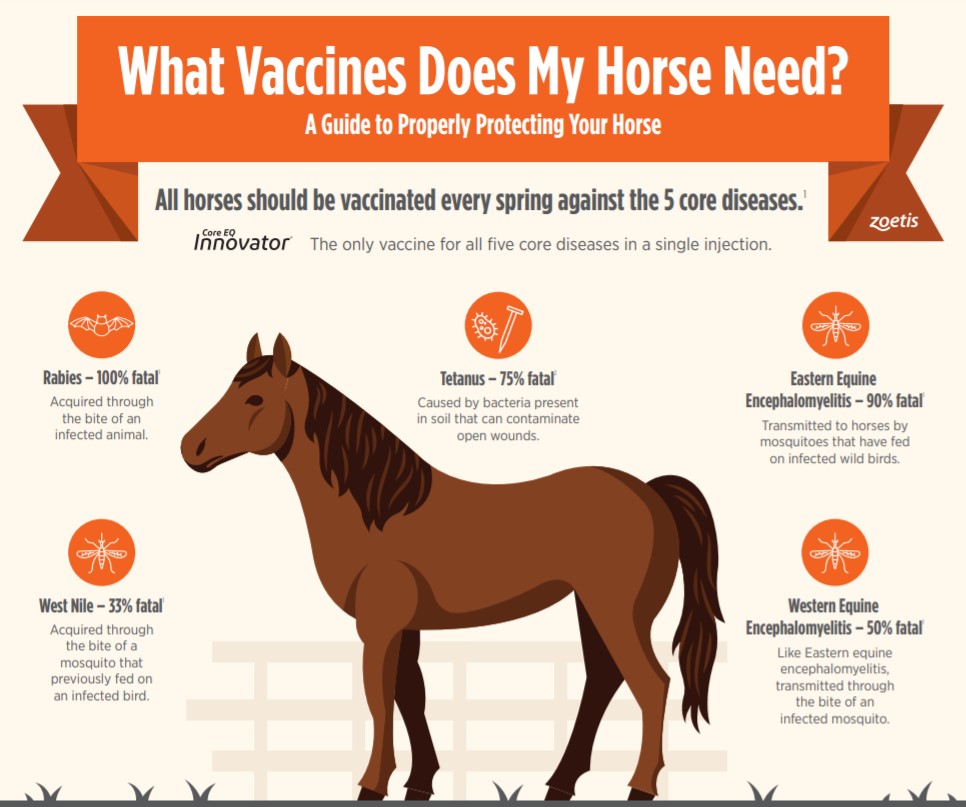
By Kevin Hankins, Senior Veterinarian, Equine Technical Services, Zoetis
Unvaccinated horses face a fatality rate of 75%
All horses are at risk for being exposed to tetanus. If your horse has exposure to soil, other animals and manure, he is at risk. Tetanus is easily transmitted, and if contracted, can be devastating to horses, with a fatality rate of 75%.1
What is tetanus?
Tetanus is a bacterial disease caused by the invasion of Clostridium tetani in puncture wounds, open lacerations, exposed tissues or surgical incisions. Present in the intestinal tract and feces of horses, other animals and humans, the bacteria can be abundant in soil and can survive in the environment for years, creating a constant risk for horses and people. Clinical signs begin with hyperresponsiveness to noise or movement and progress to a horse having erect ears, third eyelid prolapse, flared nostrils, elevated head, stiff or erect tail, and a stiff-legged gait. Symptoms can advance to muscle spasms, convulsions and death by asphyxia.
“I’ve recently seen tetanus cases in a few horses, and it is devastating to lose a horse from a disease that is very preventable,” said Leslie Schur, DVM, Desert Pines Equine. “Whether you have a young foal, a recently purchased horse or a horse with an unknown vaccination history or a horse that isn’t current on their annual vaccinations, their risks for contracting tetanus significantly increase.”
It is crucial to work closely with your veterinarian to ensure your horse has received protection against tetanus.
Read more: Tetanus: Your Horse’s Risk May Be Greater Than You Think
- Pitfalls of Fecal Checks for Parasites
- Cavallo Q&A: Horse Time for Healing
- The Last Half of Pregnancy
- Equestrian Diversity Project Spotlight: Ebony Horsewomen
- Equine Guelph at the University of Guelph in Canada presents "Journey of the Digestive Tract"
- Tennessee Walking Horse Stakeholders, Animal Protection Organizations Announce Historic Effort to End Abusive Practice of ‘Soring’ and Ensure Sound Economic Future for the Breed
- Air Quality in the Barn - That Cozy Barn May Not Be Best for Lung Health
- Practice Preparedness and Prevention - Resources on Barn Fire Prevention
- Fecal Transplants for Animals
- I Have the Wrong Horse: Now What?
- Gratitude & Horses: Healing the Cracked Places
- From the Research Farm to Your Feed Room: Applying Study Results to Improve KER EO-3
- Neuromuscular Support Nutrients
- The Roadmap to PTSD in Horses
- Is Your Horse Happy and Comfortable? Find Out with This Simple Body Exploration
- Appaloosa - The Most Beautiful Horse Breed in the World
- Stress and Your Horse's Brain
- Horse Training Power Tip: Loading Difficult Horses Into Trailers
- Electrolyte Problems in Endurance Horses
- U.S. Rep. Steve Cohen Ushers Horse Transportation Safety Act to Passage