





Health & Education
We all want the best care possible for our horses. The Heath & Education section covers both Learning Institutions, Organizations as well as many sources for equine assistance including Veterinarians and Farriers.
For those who want a to formally study horses, the Education section includes College Riding, Equine Studies, and Veterinary Schools. Learn about the wide variety of horses in the Horse Breeds section. Supplements and Treatments Therapy are also included in the section.
Everyone can learn from Fine Art and there are some specialty Museums that might surprise you.
Horses as a therapy partner enrich the lives of the disabled. These facilities are listed in our Therapeutic Riding section. To help children and young adults build confidence and grow emotionally, please see the resources available on the Youth Outreach page.
Looking for a place to keep your horse? You can find it in the Horse Boarding section. Traveling? Find a Shipping company or Horse Sitting service if your horse is staying home!
Want to stay up to date with the latest training clinics or professional conferences? Take a look at our Calendar of Events for Health & Education for the dates and locations of upcoming events.
Do we need to add more? Please use the useful feedback link and let us know!
by Jen Roytz
We’ve all heard the saying “You can lead a horse to water, but you can’t make them drink.” Horses have to be thirsty in order to consume water, and the lynchpin in that scenario is salt.
Dehydration in horses–or any animal–can quickly escalate from mild to catastrophic. Their internal environment is water-based, and salt is the driving force behind the regulation and distribution of water in and out of cells.
“Salt is 39% sodium and 61% chloride. When consumed, salt will split in the body into the separate minerals to be used independently (as electrolytes),” said Dr. Kathleen Crandell, PhD, a nutritionist with Kentucky Equine Research (KER). “Both these minerals have independent roles in the body, but mainly they work together balancing fluid movement in and out of the cells and acid-base balance, as well as electrical impulse conduction in nerves and muscles. Further, sodium is needed for transport of substances across cell membranes, like glucose.”
The more a horse exercises and sweats, the more water they need to consume to prevent dehydration, and as such the more salt they require in their diet. While forage, grass and concentrated feeds contain salt, it is not enough to adequately meet a horse’s dietary needs, especially a high-performance equine athlete, such as a racehorse, making proper salt supplementation key.
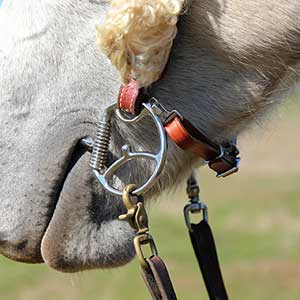
A Kansas State University associate professor and a Toklat and Myler bit expert outline warning signs for horse owners.
While enjoying a ride with your best horse, she throws her head in frustration and pins her ears. You chalk it up as an off day, one of many as of late, but it could be much more than that. “It is important to understand what the bit is doing and what to watch for,” cautions Chris Blevins, MS, DVM, Associate Professor, Equine Field Service with Kansas State University. “It is our responsibility to keep our horses comfortable.”
If your horse is experiencing bit pain and discomfort, you may notice signs of bit resistance.
There are several signs of bit resistance,” says Judy Auble, with Toklat and Myler bits. “The best way to determine whether your horse needs a new bit is to pay attention to how your horse reacts to your rein action and rein pressure.”
Could it be time to change bits? Watch for these warning signs:
- Inverting, when horses ride with their muzzles held high
- Riding behind the vertical, as horses tuck their nose into the chest
- Gaping, when horses drop their jaws behind the vertical, relieving tongue pressure
- Running through the bit or being heavy on the bit
- Riding with their tongue out of the mouth
- Consistent throwing of head and pinning of ears
- Maintain Your Horse’s Safety This Fourth of July
- Health and Exercise Science student research quantifies horse gait, movement for equine therapy
- 10 Facts About Equine West Nile Virus
- Tracking Five Millennia of Horse Management with Extensive Ancient Genome Time Series (Part 4 of 4)
- Tracking Five Millennia of Horse Management with Extensive Ancient Genome Time Series (Part 3 of 4)
- With Wet Weather Comes A New Hoof Problem: Retracted Soles
- Tracking Five Millennia of Horse Management with Extensive Ancient Genome Time Series (Part 2 of 4)
- Tracking Five Millennia of Horse Management with Extensive Ancient Genome Time Series (Part 1 of 4)
- Breeding: Make Sure You Cover the Basics!
- Vitamin C – Friend or Foe?
- Disaster Preparation Tips for Horse Owners
- Mild Equine Asthma Can Distinguish Winners from Losers on the Racetrack
- The Academic Equestrian: 10 Horse Personality Types
- Equine Temperament: Nature, Nurture or Both?
- Incorporating Mindfulness: Game Changer for Horse & Rider
- The Influence of Rider:Horse Bodyweight Ratio
- Debbie Roberts Loucks: The Big Power of Small Changes
- Study Suggests An ‘Emotional Transfer’ Between Humans & Horses
- Can Horses Really Smell Fear? Yes, And That’s Not All
- Boy with Autism Forms Incredible Bond with Horse After Being Bullied in School