





Health & Education
We all want the best care possible for our horses. The Heath & Education section covers both Learning Institutions, Organizations as well as many sources for equine assistance including Veterinarians and Farriers.
For those who want a to formally study horses, the Education section includes College Riding, Equine Studies, and Veterinary Schools. Learn about the wide variety of horses in the Horse Breeds section. Supplements and Treatments Therapy are also included in the section.
Everyone can learn from Fine Art and there are some specialty Museums that might surprise you.
Horses as a therapy partner enrich the lives of the disabled. These facilities are listed in our Therapeutic Riding section. To help children and young adults build confidence and grow emotionally, please see the resources available on the Youth Outreach page.
Looking for a place to keep your horse? You can find it in the Horse Boarding section. Traveling? Find a Shipping company or Horse Sitting service if your horse is staying home!
Want to stay up to date with the latest training clinics or professional conferences? Take a look at our Calendar of Events for Health & Education for the dates and locations of upcoming events.
Do we need to add more? Please use the useful feedback link and let us know!
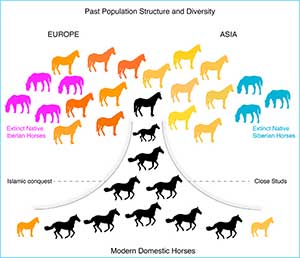
Authors Antoine Fages, Kristian Hanghøj, Naveed Khan, Alan K. Outram, Pablo Librado, Ludovic Orlando
In Brief
Genome-wide data from 278 ancient equids provide insights into how ancient equestrian civilizations managed, exchanged, and bred horses and indicate vast loss of genetic diversity as well as the existence of two extinct lineages of horses that failed to contribute to modern domestic animals.
Highlights
- Two now-extinct horse lineages lived in Iberia and Siberia some 5,000 years ago
- Iberian and Siberian horses contributed limited ancestry to modern domesticates
- Modern breeding practices were accompanied by a significant drop in genetic diversity
by Denise Steffanus
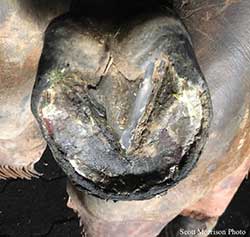
This year's wet weather and seemingly endless mud are wreaking havoc on horses' feet. Dr. Scott Morrison, head of the podiatry department at Rood & Riddle Equine Hospital in Lexington, Ky., said he has seen more cases of retracted soles this year than ever before. In addition to Kentucky, he is aware of cases in Virginia, Tennessee, and Indiana, and he suspects it is a problem in other parts of the country.
A retracted sole starts out with a thin sole. Then when the horse spends days or even weeks standing in mud while turned out, the sole weakens and the mud shoves it upward into the coffin bone, the main bone in the foot. This causes severe pain and lameness, eventually forming a large seroma (fluid-filled pocket) under the sole that can progress into a subsolar abscess or worse if untreated.
Horses with thin soles, predominantly Thoroughbreds, are most susceptible to retracted soles. Combine Kentucky's signature breed with its signature limestone-and-clay soil, and you have the perfect storm to create retracted soles.
Read more: With Wet Weather Comes A New Hoof Problem: Retracted Soles
- Tracking Five Millennia of Horse Management with Extensive Ancient Genome Time Series (Part 2 of 4)
- Tracking Five Millennia of Horse Management with Extensive Ancient Genome Time Series (Part 1 of 4)
- Breeding: Make Sure You Cover the Basics!
- Vitamin C – Friend or Foe?
- Disaster Preparation Tips for Horse Owners
- Mild Equine Asthma Can Distinguish Winners from Losers on the Racetrack
- The Academic Equestrian: 10 Horse Personality Types
- Equine Temperament: Nature, Nurture or Both?
- Incorporating Mindfulness: Game Changer for Horse & Rider
- The Influence of Rider:Horse Bodyweight Ratio
- Debbie Roberts Loucks: The Big Power of Small Changes
- Study Suggests An ‘Emotional Transfer’ Between Humans & Horses
- Can Horses Really Smell Fear? Yes, And That’s Not All
- Boy with Autism Forms Incredible Bond with Horse After Being Bullied in School
- Horses can be affected by Zika virus, study shows
- You Are Not Alone: Mental Health in Our Equestrian Community
- Are Equine Infectious Disease Outbreaks Preventable? Are We Doing Enough?
- Horse Power: Equine Therapy for ADHD
- Colorado Women in Ranching: A spirit of nurturing, sustainability is alive at San Juan Ranch
- Do You Dare to Go Bare?