





Health & Education
We all want the best care possible for our horses. The Heath & Education section covers both Learning Institutions, Organizations as well as many sources for equine assistance including Veterinarians and Farriers.
For those who want a to formally study horses, the Education section includes College Riding, Equine Studies, and Veterinary Schools. Learn about the wide variety of horses in the Horse Breeds section. Supplements and Treatments Therapy are also included in the section.
Everyone can learn from Fine Art and there are some specialty Museums that might surprise you.
Horses as a therapy partner enrich the lives of the disabled. These facilities are listed in our Therapeutic Riding section. To help children and young adults build confidence and grow emotionally, please see the resources available on the Youth Outreach page.
Looking for a place to keep your horse? You can find it in the Horse Boarding section. Traveling? Find a Shipping company or Horse Sitting service if your horse is staying home!
Want to stay up to date with the latest training clinics or professional conferences? Take a look at our Calendar of Events for Health & Education for the dates and locations of upcoming events.
Do we need to add more? Please use the useful feedback link and let us know!

by Bob Burdekin
I would like to explain how we are continually moving forward into the area of working with horses that up to this time, has been completely ignored; and that area is emotional stress management in horses.
But before we can even discuss emotional stress management and how it affects your horse we need to look at how your horse's brain works and compare it to our own.
To start with horses do not think the same way that we do; their brain is structured in a totally different manner, and how your horse uses their brain along with your input becomes the causes of the various levels of stress that your horse may experience.
When we look at and compare the brain of the horse to that of our own, the most important area to consider is the area of the "frontal lobe".
In our brain the frontal lobe is extremely large and well-developed, for this is the part of our brain that allows us to be able to process all of the information that we receive daily and that adds to our personalities, as well as our ability to develop cognitively, or reasoning abilities.
The exact opposite is true for your horse when we compare the same area the frontal lobe of your horse's brain is much more undeveloped and therefore does not give them anything close to the ability to reason through a problem even close to the ability that you or I have.
by Jennifer L Dayton
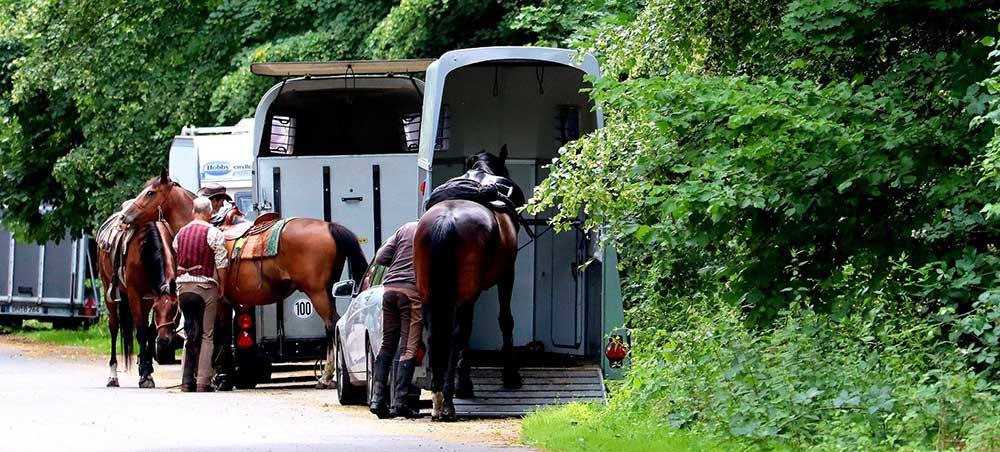
Horses walking into small, confined boxes on wheels can be a scary thing. Depending on previous experience, it can be either more or less scary. As a responsible horse owner, this is an important thing to teach your horse to do well, and to do it confidently and happily.
I believe all horses should learn this, although it is a much more significant part of the schooling of a competitive horse.
In general, whether the trailer is an angle-haul, straight-load, step-up, or ramp, a horse should follow pleasantly and comfortably behind the handler into any trailer. The horse should fit in the trailer, and not be hitting the ceiling or squished into the partitions.
To begin, most problems I have witnessed with loading have a lot to do with the horses' response to pressure on the halter. Body language is also important to recognize, as it is the horses' way of communicating with you. Some horses are terrified; some horses just say no, and have gotten away with saying no; and others have constant worries - not fitting properly, having had a bad experience, slipping or falling.
(A note to all those who drive a horse trailer: from those of us humans suffering from motion sickness - many of you make us feel ill with your quick turns and rapid accelerating and heavy braking; we have to wonder how many horses suffer the same way, and endure rough rides, knocking them about and challenging their balance constantly... not a good thing for horses to want to go back in the trailer for.
The most common problems encountered with trailering involve: the horse backing up, pulling back rapidly, refusing to move at all, dodging from side to side, or a combination thereof. Again, respect for the parts of the halter will help immensely.
If the handler applies pressure to the headstall of the halter, the horse should move forward. Pressure on the noseband should cause the horse to yield, and pressure on the sides of the halter should catch the side-to-side problems. The main pressure that needs to be responded to in loading is the headstall.
Read more: Horse Training Power Tip: Loading Difficult Horses Into Trailers
- Electrolyte Problems in Endurance Horses
- U.S. Rep. Steve Cohen Ushers Horse Transportation Safety Act to Passage
- A Vet’s Guidance for Saving Horses in Need, Plus Training Your Eye to Nail the Distance
- Grazing the Metabolic Horse
- Disaster Preparedness
- Need Help Reopening Your Equine Business Amidst Covid-19? Barton Rodgers TempDefend™ Sensor Solution is Your Answer!
- Why I Did the Mustang Makeover—and Why I’d Do It Again
- Improve the Horse’s Balance, Movement, and Self-Carriage with These Easy Tail Exercises
- Q&A: Managing Arthritis in Horses
- The Benefits of Riding to Music
- How to Feed a Severely Neglected Rescue Horse
- Josh Lyons with Lyons Legacy Partner With Horses in Need
- Equine Disaster Preparation and Response
- Colostrum -- An Exceptional Superfood!
- What the Heck is PEMF Anyway?
- Deworming Your Horse? Reference this Comprehensive Q&A
- Equine Enteric Coronavirus
- Is Your Horse Protected Against These Disease Risks?
- Equine-Facilitated Psychotherapy: Facing Trauma With a Horse by Their Sides
- University of Kentucky’s Department of Veterinary Science Responds to Nocardioform Placentitis