





Health & Education
We all want the best care possible for our horses. The Heath & Education section covers both Learning Institutions, Organizations as well as many sources for equine assistance including Veterinarians and Farriers.
For those who want a to formally study horses, the Education section includes College Riding, Equine Studies, and Veterinary Schools. Learn about the wide variety of horses in the Horse Breeds section. Supplements and Treatments Therapy are also included in the section.
Everyone can learn from Fine Art and there are some specialty Museums that might surprise you.
Horses as a therapy partner enrich the lives of the disabled. These facilities are listed in our Therapeutic Riding section. To help children and young adults build confidence and grow emotionally, please see the resources available on the Youth Outreach page.
Looking for a place to keep your horse? You can find it in the Horse Boarding section. Traveling? Find a Shipping company or Horse Sitting service if your horse is staying home!
Want to stay up to date with the latest training clinics or professional conferences? Take a look at our Calendar of Events for Health & Education for the dates and locations of upcoming events.
Do we need to add more? Please use the useful feedback link and let us know!
by Kentucky Equine Research Staff
Horse owners, veterinarians, and researchers can measure a horse’s body temperature in multiple ways. By far the most common method is the use of digital rectal thermometers. While simple to use, these devices may offer inconsistent readings and pose a safety risk to handlers and horses.
Though less common, other ways of recording body temperature include a disposable sensor attached to the underside of the horse’s tail, primarily used for tracking temperatures over long periods, and an infrared thermometer, thought to have a weak correlation to core body temperature and to be easily influenced by external factors.1
At Kentucky Equine Research, caretakers often record body temperature several times daily. For this reason, they rely on percutaneous thermal sensing microchips (PTSMs), which provide faster and more accurate readings than traditional methods.
As their name implies, PTSMs are small devices, no larger than the microchips used for pet identification. They are implanted into specific muscles of the horse. Thirty-three horses across three farms at Kentucky Equine Research have PTSMs placed in a gluteal muscle, with an average muscle depth of 1.81 ± 0.56 cm for the horses residing in Florida at the Kentucky Equine Research Performance Center.
Twelve of the 33 have a second microchip in the pectoral muscle at a muscle depth of 1.42 ± 0.31 cm.2 The gluteal muscles form the large mass over the horse’s croup, while the pectoral muscles lie between the front legs along the chest.
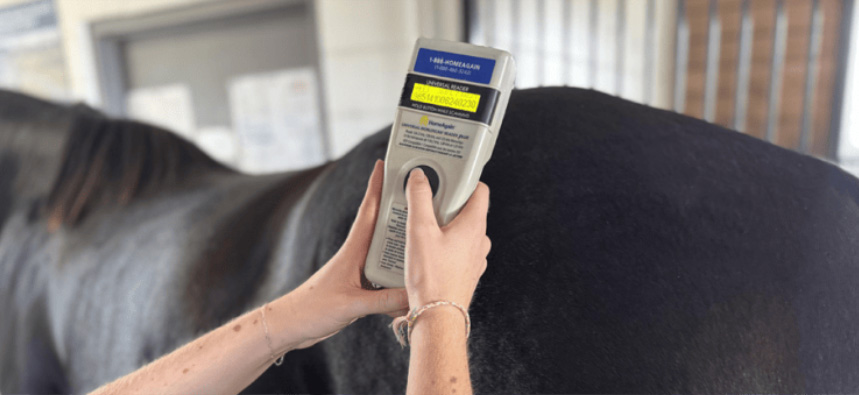
Once implanted, PTSMs can be scanned immediately with a HomeAgain microchip reader, which displays the horse’s temperature instantly on-screen. Users can also link the microchip to a unique identification number for each horse and keep a record of the data using the EquiTrace app.
This process can be repeated as many times as needed, as the microchips have lifelong battery power, and the microchip readers are rechargeable.3
Ease of reading is especially important at Kentucky Equine Research. With PTSMs, researchers can safely track a horse’s body temperature while the horse is exercised on a high-speed treadmill, a feat impossible with traditional rectal thermometers.
The use of PTSMs has greatly influenced the welfare of horses by detecting early signs of unusual changes in body temperature, such as fever or heat stress. This is especially important in horses undergoing strenuous exercise in hot and humid conditions where heat dissipation is difficult.1
Kentucky Equine Research has put this technology to good use during research trials, allowing scientists to better understand the efficacy of different cooling methods after exercise.2
Percutaneous thermal sensing microchips represent a major advancement in equine health monitoring and research.
This article was written by Kelly Dawkins, a year-long intern at Kentucky Equine Research. As part of the intern program, participants are encouraged to contribute to Equinews. Learn more about the internship program.
Reprinted courtesy of Kentucky Equine Research. Kentucky Equine Research is an international equine nutrition, research, and consultation company serving horse owners and the feed industry.
Our goals are to advance the industry's knowledge of equine nutrition and exercise physiology, apply that knowledge to produce healthier, more athletic horses, and support the nutritional care of all horses throughout their lives. Learn more at Kentucky Equine Research.
1Kang, H., R. R. Zsoldos, J. E. Skinner, J. B. Gaughan, V. A. Mellor, and A. Sole-Guitart. 2022b. The use of percutaneous thermal sensing microchips to measure body temperature in horses during and after exercise using three different cool-down methods. Animals 12:1267.
2Pagan, J. D., and R. W. Springer. 2025. Using percutaneous thermal-sensing microchips to assess the efficacy of active versus passive cooling in exercising Thoroughbred horses: An integrative data analysis. Journal of Equine Veterinary Science 148:105538.
3Kang, H., R. R. Zsoldos, S. M. Woldeyohannes, J. B. Gaughan, and A. Sole Guitart. 2020. The use of percutaneous thermal sensing microchips for body temperature measurements in horses prior to, during and after treadmill exercise. Animals 10:2274.
There are more informative articles in our section on Health & Education. While you're here, be sure to visit our Curated Amazon Store.
Are you interested in promoting your business or sharing content on EIE? Contact us at info@equineinfoexchange.com
By Juliet M. Getty, Ph.D.
p>The quantity of protein in the diet is important but even more so, is its quality. To achieve this, we need to include additional protein sources to a forage-based diet. It all has to do with the way the body digests and utilizes protein.Hay provides protein, but it’s of poor quality
Its protein is digested down to individual amino acids. This process starts in the stomach and is completed in the small intestine. They are absorbed into the blood stream and travel to tissues within your horse’s body to be reassembled into long, branched chains of amino acids to create proteins that are specific to your horse’s needs.
There are hundreds of proteins in the body, some of which include those in the muscles, joints, skin, and hooves, as well as digestive enzymes, antibodies, and some hormones.
Grasses and grass hays should offer the foundation of your horse’s diet. But their protein content is of poor quality. That means that while they do offer amino acids, including essential amino acids (those which the horse’s body cannot produce or produce in sufficient quantity), they are inadequate in number and proportion.
So, when the amino acids from hay digestion reach a tissue, muscle for example, the muscle requires specific amino acids in the right number and proportion to build new muscle proteins.
Left over amino acids cannot be saved for later
With a poor-quality protein, there will be many amino acids left over because some key amino acids are not available in sufficient quantity to produce muscle protein, as in our example. The left over amino acids cannot be saved for later. Instead, they go to the liver where they are broken apart - a process known as “deamination.”
The amino acid is divided into two components: ammonia (which later gets converted to urea and excreted in the urine**), and an organic acid. The organic acid portion can undergo biochemical changes in one of three directions:
1. Converted to glucose. Most amino acids, once deaminated, can be converted to glucose. Glucose is the predominant blood sugar and is the necessary energy source for your horse’s nervous system, including his brain.
Once blood glucose rises, the pancreas responds by secreting insulin to get the glucose into many of his body’s tissues. This should raise a “red flag” for owners of insulin resistant horses, since it’s not just sugar and starch that raises blood glucose - excess amino acids can, as well. This will only occur, however, if the diet is low in carbohydrates.
Forages are generally high enough but if you are restricting forage to help your horse lose weight, he will need to get glucose from somewhere. He will likely lose muscle mass, since muscle offers a large amount of available amino acids, which can be deaminated and converted to glucose (through a process known as gluconeogenesis).
In addition to muscle loss, he will utilize what protein he has in his diet to also offer glucose to keep his nervous system functioning.
2. Burned for energy. If your horse’s diet is low in calories (referred to as “digestible energy” on your hay analysis report), he will use protein, as well as carbohydrates and fats, to meet his energy needs. Carbohydrates (sugars, starch, and digestible fibers), as well as fats are supposed to be used for energy.
But protein is not; it’s supposed to be used for body protein synthesis. If your horse is not getting enough carbohydrates and fat in the diet, the dietary protein will be “wasted,” burned for energy, and not used for its intended function.
3. Converted to fat. Now isn’t that ironic? If you are feeding a low starch/low sugar hay to help your horse lose weight, and this is the only source of protein, that protein could actually be converted to body fat!
This would only happen, of course, if the glucose and caloric needs have already been met. But feeding an appropriately low sugar/low starch hay, free-choice, without any additional source of protein (amino acids), could make your horse get fatter.
The solution is not reducing forage. That would only make the amino acids be used for energy, for glucose (raises insulin), or encourage muscle loss. The solution is to provide enough quality protein so that the fourth and desirable outcome occurs: amino acids from hay digestion can be kept intact, not deaminated.
Add a different protein source
When amino acids are kept whole and not destroyed in the liver, they can be “strung” together in specific patterns to produce the protein needed within the body. The best way to ensure this is to add another protein source that has a different amino acid profile. That way, it can enhance the amino acid pool diversity.
Hence, more amino acids are available for your horse’s health maintenance and repair.
An analogy would be making a beaded necklace where every fourth bead is red. You buy a bag of beads and there are some red ones, but you find that you cannot make a necklace at the length you’d like it because the bag does not have enough red ones (like feeding poor-quality protein such as only hay).
So, you go out and buy a different bag of beads with lots of red ones (another protein source). Now you have enough red ones to make a necklace, and maybe even more than one necklace.
The amino acid variety is far more important than the protein percentage
If your hay is high in protein, but it is the only source of protein, many amino acids will be destroyed. To reduce this, you'll want to start by feeding a variety of grasses, not just one type of grass hay. Adding alfalfa will also help.
But a preferable approach is to offer a small amount of non-grass feedstuffs such as ground flaxseeds, chia seeds, hemp seeds, and other whole foods. This results in an assorted group of amino acids, sufficient to meet your horse’s needs.
Bottom line
To offer your horse the amino acid building blocks he needs to build and repair body proteins, it is important that the diet contain a variety of protein sources to maintain an adequate amino acid pool. If this pool is missing too many specific amino acids, many will ultimately be deaminated in the liver, rendering them unusable for body protein production.
Instead, they can be burned for energy, converted to glucose, and even stored as fat. Adding a small amount of protein-rich whole foods increases the number of intact amino acids, helping your horse remain strong and healthy.
** If your horse’s urine seems particularly strong-smelling, don’t necessarily assume that it is because he is getting too much protein. It could be because his protein intake is of poor quality, causing deamination of unused amino acids. Improving the protein quality will reduce the urea content in the urine.
This article originally appeared on Getty Equine Nutrition and is published here with permission.
Find more informative articles in our section on Health & Education. While you're here, take a look at our Curated Amazon Store.
Are you interested in promoting your business or sharing content on EIE? Contact us at info@equineinfoexchange.com
- Why is the American Quarter Horse the Most Popular Breed in the World?
- Get Your Goat! A Horse Companion Option
- Western Saddle Fitting 101: Tips on Proper Fit, Selecting Saddle Pads, Cinches and More
- Biggest Barriers to Human-Led Exercise in Horses
- The Importance of Canine Oral Health - Dog Dental Powders
- Ensure Your Horse's Dental Health
- Midnight Snacks: When Do Stalled Horses Eat During the Night?
- 5 Tips About Equine Vaccines
- Five Things About Performance Horse Gut Health
- Using Ultrasound to Diagnose SI Joint Disease in Horses
- Hemp Hurd Bedding for Horses
- What Pasture Snacks Mean for Horse Health
- How would you help a rider who struggles with combinations?
- Descending Gymnastics: Why Ending Smaller Can Be Smarter
- Horse Management Survey Results: A Nutritionist’s Perspective
- Six Key Questions About Platelet-Rich Plasma for Horses
- Potomac Horse Fever
- Drinking Behavior of Horses: Six Facts About Water Intake
- Protein and Muscle Recovery for Performance Horses - an excerpt from Helping All Horses Live Healthier Lives
- Evaluating Horses for Back Pain