





Health & Education
We all want the best care possible for our horses. The Heath & Education section covers both Learning Institutions, Organizations as well as many sources for equine assistance including Veterinarians and Farriers.
For those who want a to formally study horses, the Education section includes College Riding, Equine Studies, and Veterinary Schools. Learn about the wide variety of horses in the Horse Breeds section. Supplements and Treatments Therapy are also included in the section.
Everyone can learn from Fine Art and there are some specialty Museums that might surprise you.
Horses as a therapy partner enrich the lives of the disabled. These facilities are listed in our Therapeutic Riding section. To help children and young adults build confidence and grow emotionally, please see the resources available on the Youth Outreach page.
Looking for a place to keep your horse? You can find it in the Horse Boarding section. Traveling? Find a Shipping company or Horse Sitting service if your horse is staying home!
Want to stay up to date with the latest training clinics or professional conferences? Take a look at our Calendar of Events for Health & Education for the dates and locations of upcoming events.
Do we need to add more? Please use the useful feedback link and let us know!
The equine respiratory system can be a major cause of poor performance or premature retirement from competition. A proven way to support the health of the respiratory system is by reducing resistance to breathing at the nose so horses breathe easier. To understand why, recall that when exercising horses don’t breathe through their mouth like humans, they only breathe through their nose. This means that oxygen which is vital for working muscles is not available if breathing through the nose is impaired.
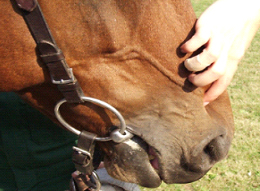
If you place your hand a few inches above your horse’s nostrils, you’ll feel a region that is unsupported by bone or cartilage that collapses inward when you press into it.
During intensive exercise, this tissue overlying the nasal passage collapses inward which reduces the diameter of the nasal passage, causing increased resistance of airflow to the lungs when air is needed most. In fact, during exercise over 80% of the resistance to inhaling air into the lungs occurs in the upper airway and over 50% of the upper airway resistance is caused by the nasal passages.
FLAIR® Equine Nasal Strips are clinically proven to support the tissue that collapse into the nasal passages so horses breathe easier during intensive exercise.
Breathing easier helps horses optimize their stride, reduce fatigue and conserve energy. At the gallop, horses take a single breath with each stride. A horse struggling to move air in and out of the lungs will shorten its stride or consume more energy when taking in air that otherwise could be used to power the skeletal muscles. In other words, anything that makes breathing difficult will impair stride and performance. It can cause anxiousness or loss of concentration, too.
Read more: Breathing Easy: A Key to Equine Health and Performance
by Juliet M. Getty, Ph.D.
Alfalfa can be an excellent addition to most horses' diets, even for those who are insulin resistant (IR). I often recommend feeding it because it boosts the overall protein quality of a grass-hay diet and, in general, enhances the horse's muscle tone, immune system, and overall health.
But some people just don't want to feed alfalfa; they believe it causes laminitis. And after years of working with horses, it appears that it may, in fact, lead to laminitis in some horses. I found this to be very puzzling since alfalfa is low in sugar and starch, even lower than most grass hays. Its high protein content, however, makes it more caloric, which can be a problem for IR horses who need to lose weight.
But I always included some, albeit a small amount.
Nevertheless, there appears to be something about alfalfa that troubles some IR horses. After giving this considerable thought, I believe I can shed some light on why this may be the case. There are two plausible reasons, both leading to excess blood glucose and the concomitant secretion of insulin:
1. Excess protein in the diet
2. Preservative often sprayed on alfalfa hay
Excess protein - quality vs quantity
All proteins consist of long, branched chains of amino acids. Upon digestion, amino acids are free to enter the blood stream and travel to individual tissues, where they are recombined in a very specific order to produce the protein needed by that particular tissue (e.g., blood, lungs, heart, liver, skin, bones, joints, etc.).
There are 22 amino acids, of which ten are considered essential -- they cannot be produced within the horse's body or they cannot be produced in adequate quantity to meet the horse's need. For a protein to be of high quality, it must contain all of the essential amino acids in proper proportion.
Plant protein sources are potentially limiting in the essential amino acid, lysine. When lysine is low, protein synthesis comes to a halt. The National Research Council (NRC) has established lysine requirements for all horses. As of yet, requirements for the other nine essential amino acids have not been quantified, though recent research has shown that threonine may be the second limiting amino acid.
To ensure your horse has an ample amino acid pool in his bloodstream from which to synthesis proteins within his body, it is best to feed a variety of protein sources to improve the quality while not overdoing the quantity.
Read more: Alfalfa and the Insulin Resistant Horse - The True Story
- Burning And Learning?
- The Canadian Horse: Discover a Versatile Breed Rich in History
- Core Equine Disease Risks Increase Amid Mosquito Season
- Equilume Stable Light Can Influence Body Composition and Biological Rhythms in Horses-in-training
- Inflammation: It’s Not Just In Joints
- Horsepower: How Digital Technology is Transforming the Equine World
- Exercising and Training Horses in Hot Weather
- Choose Hemp Instead of Soy for Your Horse!
- Equine Odontoclastic Tooth Resorption and Hypercementosis
- What is the Ideal Conditioning Program for an Eventer?
- Is Your Horse a Slave in a Sand Box?
- Surprise! It's Twins!
- Dental Surgery and Extractions
- A Rejected Foal and a Brokenhearted Mare Saved Each Other
- Miniature Horse Therapy: Great Big Good Things in Small Packages
- Man O’ War Project Helping the Soldiers of War Heal
- Is Icing Still a Valid Treatment for Injuries?
- Must-Have Secret Training Tools
- My Daughter is My Hero
- Horse Training: 7 Essential Steps for Safely Handling Your Horse's Feet