




Health & Education
We all want the best care possible for our horses. The Heath & Education section covers both Learning Institutions, Organizations as well as many sources for equine assistance including Veterinarians and Farriers.
For those who want a to formally study horses, the Education section includes College Riding, Equine Studies, and Veterinary Schools. Learn about the wide variety of horses in the Horse Breeds section. Supplements and Treatments Therapy are also included in the section.
Everyone can learn from Fine Art and there are some specialty Museums that might surprise you.
Horses as a therapy partner enrich the lives of the disabled. These facilities are listed in our Therapeutic Riding section. To help children and young adults build confidence and grow emotionally, please see the resources available on the Youth Outreach page.
Looking for a place to keep your horse? You can find it in the Horse Boarding section. Traveling? Find a Shipping company or Horse Sitting service if your horse is staying home!
Want to stay up to date with the latest training clinics or professional conferences? Take a look at our Calendar of Events for Health & Education for the dates and locations of upcoming events.
Do we need to add more? Please use the useful feedback link and let us know!
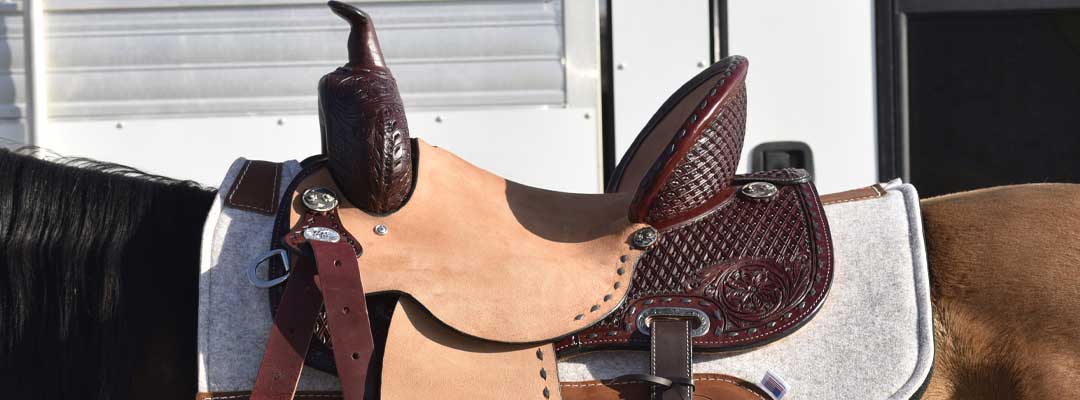
Curious what the differences are between the types of Western saddles produced?
Whether you’re running barrels, chasing calves, trail riding or showing in an arena, there are different Western saddles made for your specific riding discipline. Learn what makes each type of Western saddle unique, with insights from our friends, Circle Y. Have more questions? Call or email our Valley Vet Supply saddle experts at saddles@valleyvet.com, and they are more than glad to help!
Trail saddles- Specifically designed for comfort and security, these saddles often have a padded, deeper seat and are lighter weight. These saddles will often have many saddle strings hanging off as well, used to tie jackets and gear to during the trail.
Show saddles and Trainer saddles - When riding any of the all-around events, such as western pleasure or horsemanship, riders will often have a show saddle equipped with tooling in the leather, silver and bling. These saddles will have a shorter horn, a low cantle, and a fairly flat seat that often times has a balance point in the center for proper riding position.
Barrel saddles- These saddles are very lightweight. They often have a skinny, tall horn to allow for easy grip and have a deep seat to keep the rider secure at high speeds. These saddles often have rough-out seats, seat jockeys, and fenders for grip and shorter skirts to avoid interference with the horse’s hip in sharp turns.
Reining saddles - These saddles have a medium-height horn, often times have cutout skirts to allow for better leg contact, and are medium to heavy in weight. These saddles have a front cinch only and may have added silver on them for show.
Cutting saddles - These saddles have a distinctive tall, narrow horn for easy gripping with the hand, and a long, flat, smooth seat allowing no rider interference to the horse. These saddles will have both a front and rear cinch and often times, rough-out fenders for better grip.
Roping saddles - Roping saddles are a heavier, sturdier saddle with a reinforced wood tree made to withstand ranch work and roping. The horn is often thick and wrapped to help it withstand the weight of a rope on a calf. These saddles almost always have both a front and rear cinch to keep the saddle from rocking forward when a calf is roped. Roping saddles also have wider, bigger stirrups.
Shop Valley Vet Supply’s wide selection of saddles and tack available, and for more information, please contact saddles@valleyvet.com.
By Kentucky Equine Research Staff
Every aspect of equestrianism features a language of its own. Coat color enthusiasts can define every shade and nuance; tack specialists can accurately describe a barrel full of bits using a specialized vocabulary. For nutrition aficionados, a robust wordlist is also in play. Just as forage is the foundation of a horse’s diet, let’s review some common forage-related terms that may be useful in everyday stallside conversation.
Before we begin, a word about “forage.” While some people stumble over this term, forage simply means the edible parts of plants, other than separated grain, that serves as feed for horses, or that can be harvested for feeding. Examples of forage include pasture, hay, haylage, hay pellets, and hay cubes.
“Forage quality” refers to characteristics that make forage valuable to horses as a source of nutrients, typically the combination of energy that determines its potential to fuel work in performance horses, growth in youngsters, and milk production in broodmares, and other essential nutrients such as protein, vitamins, and minerals.
Without further ado, do you know these common forage terms?
Cool-season grasses – grass species best adapted to growth during cool, moist periods of the year, commonly having temperature optimums of 59-77° F (15-25° C).
Fescue – a cool-season grass often used in forage stands for horses. Tall varieties are sometimes infected with a fungus, specifically the endophyte Acremonium coenophialum, that lives symbiotically with the plant. Exposure of horses to endophyte-infected tall fescue can elicit a toxic response, called fescue toxicity, which is especially problematic in pregnant mares and characterized by increased gestation length, lack of milk, placental abnormalities, and mare or foal death.
Fiber – a component of plant cell walls that provides strength and structure to the plant. As a plant matures, the fibrous component increases and lengthens to support the plant. Fiber is considered a structural carbohydrate. Horses are capable of digesting fiber due to microbial fermentation that occurs in the hindgut; because of this physiological feature, horses require fiber in their diets for optimal health.
Haylage – product resulting from ensiled forage with about 45% moisture in the absence of oxygen.
Legume – a large and agriculturally important family of flowering plants that produce seed pods; when produced and harvested under similar conditions, legume hays are generally higher in protein, energy, and certain minerals than grass hays.
Long-stemmed forage – this term speaks specifically to the physical length of the plant material or stems as it is presented to the horse. Long-stemmed forages include hay and some pasture plants. When forage is chopped or ground and formed into cubes or pellets, it is no longer considered long-stemmed forage.
Maturity – an arbitrary term to indicate the adult (or older) stages of plant development or its readiness to harvest. In general, mature forages, especially overmature plants, have less nutritional value than younger plants.
Overgrazing – grazing horses on a given area that, if continued to the end of the planned grazing period, will result in less than satisfactory performance (weight loss, etc.) or less than satisfactory pasture forage production; not to be confused with overstocking, which is horses on a given area that will result in overuse if continued to the end of the planned grazed period. Continued overstocking often leads to overgrazing.
Ration – perhaps not specifically related to forage, but a ration is the total amount of feed allotted to one animal for a 24-hour period.
Warm-season grass – grass species best adapted to growth during the warmer part of the year and usually dormant during cold weather or injured by it; commonly having temperature optimums of 80-95° F (27-35° C).
Read more: Know Thy Forage: Ten Forage-Related Terms That May Be New To You
- The Emergency Stop with Julie Goodnight (3:05)
- Sample Lesson on First Trot with Andrea Boone (16:49)
- Horse Heatstroke and Exhaustion
- Putting Weight on a Skinny Horse
- The Export Journey of the Icelandic Horse (22:17)
- Why Wear a Helmet? Riders Share Harrowing Close Calls
- Equine Affaire Educational Program - Monty Roberts performs Join-Up with a Wild Horse (22:37)
- Veterinarian, Equestrian Advises on Caring for the Senior Show Horse
- Rood & Riddle "Stallside" Podcast - Scratches and Hives Oh My! with Dr Julia Miller
- Your Child Wants to Ride a Horse! What Should You Do?
- Biosecurity Education & Training
- Sample Lesson: First Lope with Tara Reimer (17:12)
- Obese Equine Athletes: Are These “Unhealthy” Healthy Horses?
- Facility Design with Biosecurity in Mind
- What's In Your Hay?
- Reading Horse Behavior with Dale Rudin (7:55)
- Why Do Horse Breeders Terminate a Twin?
- Rood & Riddle Stallside Podcast: The Importance of Ultrasound with Dr Colton Thacker (26:33)
- Infection Disease Control tips for Horse Farms - Dr. Scott Weese (15:62)
- Why the Sudden Behavior Change in My Horse?