





Health & Education
We all want the best care possible for our horses. The Heath & Education section covers both Learning Institutions, Organizations as well as many sources for equine assistance including Veterinarians and Farriers.
For those who want a to formally study horses, the Education section includes College Riding, Equine Studies, and Veterinary Schools. Learn about the wide variety of horses in the Horse Breeds section. Supplements and Treatments Therapy are also included in the section.
Everyone can learn from Fine Art and there are some specialty Museums that might surprise you.
Horses as a therapy partner enrich the lives of the disabled. These facilities are listed in our Therapeutic Riding section. To help children and young adults build confidence and grow emotionally, please see the resources available on the Youth Outreach page.
Looking for a place to keep your horse? You can find it in the Horse Boarding section. Traveling? Find a Shipping company or Horse Sitting service if your horse is staying home!
Want to stay up to date with the latest training clinics or professional conferences? Take a look at our Calendar of Events for Health & Education for the dates and locations of upcoming events.
Do we need to add more? Please use the useful feedback link and let us know!

Photographer Drew Doggett’s latest series, Icons, powerfully explores horses in ethereal and ancient settings. This 28-image print series, Doggett’s newest addition to his global documentation of horses, offers a nuanced and captivating look at their grace, strength, and lasting cultural impact.
The studio of award-winning fine art photographer, best-selling author, and filmmaker Drew Doggett is thrilled to announce the release of Icons, his latest series. Icons illuminates the beauty of horses in scenes existing somewhere between reality and fiction.
This series is a bold, visionary look by one of the most preeminent photographers of these animals. Each image borders on the surreal by incorporating ancient architecture, delicate fields of lavender, off-white, natural backdrops, endless expanses of salt flats, or epic, otherworldly rock formations. These images hold a sense of magic, revealing the heart and soul of these beloved animals at the tenuous edge of fact and fable.
Beyond the breathtaking, fantastic natural backdrops, other images invoke the wild freedom of a life spent on horseback and the dream of the West that is central to the American story. There are also portraits of Friesian horses, a breed of jet-black animals with silken manes and sheeny coats that feel both masculine and feminine at the same time. The images in Icons are rendered in Doggett’s signature tone, texture, and detail, bringing a timeless story to life in a richly evocative black-and-white palette. It is the latest addition to his best-selling equestrian photography.
ABOUT THE ARTIST
Through a fashion-inspired lens, photographer and filmmaker Drew Doggett tells extraordinary stories of diverse cultures, animals, places, and communities. Drew’s photography can be found globally in private and public collections, notably the Smithsonian African Art Museum, the Waldorf Astoria, the Four Seasons, and those of Alec Baldwin, Gloria Steinem, Nicole Ari Parker, and Eric Church. He has received over 130 awards and honors for his images and films. Drew’s artwork has been featured in many publications, including the Wall Street Journal, CNN, Conde Nast Traveler, Architectural Digest, Forbes,
Bloomberg, Fortune, The Daily Mail, and Outside Magazine. He has partnered with brands like Ralph Lauren, Hasselblad, and Leica. His most recent book, Untamed Spirits: Horses Around the World, is a best-seller on Amazon; its second printing is starting soon.
You can view Icons online at Drew Doggett.
You can find more interesting stories in our section on Recreation & Lifestyle.


The following is an excerpt from The Horseman’s Tale by Tom Equels.
With a father’s eye and a father’s pride, I watched Monty develop. No one ever admits it, but every father has that “apple of my eye,” and Monty was my favorite. Again, in both his look and demeanor, he reminded me of my father. He attended Eton College in England. “College” in England had a different meaning than in the United States. It was a rough equivalent to a private high school for students over the age of sixteen to prepare for admission to a university. Monty graduated from Eton with distinction. As a fencing champion, he led the Eton team to capture the All-England Hampton Trophy, and as an individual, he won England’s Junior Saber Championship.
Consistent with our plan to bring him on slowly, Sean Mac started racing as a four-year-old. In America, the top racehorses started as two-year-olds, but for jumping and distance, waiting until three was far better for the horse. With Monty up, four-year-old Sean Mac won a couple of starter-level stakes races in Ireland. Then, as a five-year-old, he won both the Irish and French Nationals. In the English Grand National that year, Monty and his black stallion were sorely and deliberately fouled by two English competitors who were clearly working in concert. Even though it was deliberate, there was rarely any meaningful recourse in the steeplechase for a protest. It was a forty-horse free-for-all—rules be damned. Still, Sean Mac surprised us all in what turned out to be the equine version of a vicious rugby maul.
It was racing drama at its best. Sean Mac was blocked, with a slowing horse on each side, their riders raining blows with their leather bats. Monty’s public-school fencing skills saved the day, deflecting blow after blow with his own racing bat. Still, he saw no clear way out, trapped in an ever-pressing equine vise.
Then, Sean Mac lunged to the right and bit off the blocking gray gelding’s left ear, leaving the injured horse screaming and spraying blood. Monty, in an equally possessed moment, instantly took advantage of his adversary’s shock, slashing his racing bat across the face of the gray horse’s jockey. It broke the man’s nose and sliced open his cheek. The wounded gelding reared up and threw his equally injured rider to the ground. Sean Mac then sprinted through the chaos-driven gap and sought to take the lead, but he couldn’t make up the lost time. He came in third by eight lengths.
At the time, Andy Warhol’s famous expression came to my mind: “In the future, everyone will be famous for fifteen minutes.” This Grand National melee looked like Monty and Sean Mac’s fifteen minutes of fame. Actually, “infamy” is the proper word. All of England’s prominent but notoriously muckraking newspapers smeared big front-page photos of the critical moment of Sean Mac biting and Monty slashing. Rider and horse were quickly branded by the English press as “The Savages” in sports page headline after headline.
In an act of bald-faced temerity, the two English riders who incited the melee filed a protest, seeking to ban Monty and Sean Mac from future competition in England. By the grace of God, an up-and-coming English filmmaker had videoed the whole incident, start to finish, for a documentary he was doing. He sent copies of the tape to both the track stewards and the BBC. The stewards, who were “the law” on the racetrack and unwilling to bend to chauvinistic pressure, exonerated Monty and Sean Mac, and in a rare act censured and fined—sua sponte—both English jockeys. The BBC backed the stewards by repeatedly broadcasting the video, including a follow-on stamp of royal approval with a video clip of the Prince of Wales, stating: “In England, we believe in fair play and good form.”
It seemed there was justice for an Irishman, and an Irish horse, in England after all.
As a six-year-old, winning every race he entered, Sean Mac was invincible. Sally, Katie, and I traveled to England for the following year’s Grand National and were seated in Viscountess Spennithorne’s box, near the royals. It was a family affair, with Lady Elizabeth, Eamon Cavanaugh, Rory and his wife Glenda, Gerry and Maureen, and Fitz with his date and future wife, Lady Margaret. A royal cousin, Maggie was craquant, smart, and funny, and beloved by her grand-aunt, the queen.
With Sean Mac’s fame, for the first time “Jake Montgomery” stood publicly as a player on a European stage. Even though I avoided public attention, interviews and the like, my increasing public profile was a problem with my undercover career. I was co-owner, trainer, and breeder of Sean Mac, rapidly emerging as the most famous horse in Europe. SOCOM, without even consulting with me, took me off field duty. When I voiced a half-hearted complaint to my handler, a thirty-something civilian who was probably an NSA or CIA bureaucrat, insult was added to injury with, “You are past twenty years of service and getting too old to do the job anyway.”
With that, the Marine Corps promptly promoted me from Lieutenant Colonel to Colonel, setting the stage for my imminent retirement. James Gerald Long was retired too, with a fake death certificate (heart attack) and a marked grave at Shannon’s Lemenagh Cemetery.
These were his only rewards for years of service. In a goofily macabre hat-tip to my Irish alter ego (may he rest in peace), I visit him every now and then to lay flowers on his grave.
As part of my makeover, my public coming out, when I arrived in London for the English Grand National, I sported a new look. First, in an offering to the retirement gods, I put on an extra fifteen pounds. That was all it took to soften the lean-and-mean look. I draped the new me in a neat close-trimmed full beard, a tailored gray Canali day suit, a matching suede flat cap, and Ray-Ban Aviator sunglasses. Not a trace of my secret alter ego could be seen. The aging movie star look was my newly crafted public persona, my new mask. I liked the look! Been that way, with an ever-growing touch of gray, ever since.
The Grand National was a true extravaganza. We didn’t have anything like it in America—a free-flowing festival, with more than half a million people converging on Aintree Racecourse, near Liverpool. In the Grand National race, there was no starting gate, and the field of competitors was always enormous. Sean Mac was the favorite among the mob of thirty-six entered horses. The race had two false starts before getting the runners away clean.
Monty, not wanting a repeat of what happened the previous year, quickly took the lead, showing tremendous early speed for a race of more than four miles with thirty jumps. The field then broke into a six-horse pack and thinned out from there. A hush overtook the crowd, with murmurs that the fast pace couldn’t be maintained for the distance. Then Monty and Sean Mac put down more early speed, leaving the pack behind. It reminded me of the greatest race I’d ever seen, when Sean Mac’s grandsire, Secretariat, won the Belmont by almost a furlong in world-record time.
Monty struck for home, leaving the number-two horse, Escalon, a furlong behind with only half a mile left to run. Wire to wire, I thought it a bold move and I knew it was a complete departure from the pre-race plan laid out by Rory. As they neared the finish, Monty tried to slow Sean Mac to preserve the horse. The win was secure, but the stallion was not slowing down. Yes, this was Old Pete’s son for sure, running the race his way. Sean Mac increased the pace for the finish, finding a reservoir of blinding speed. Monty did the only thing possible: enjoy the ride. Gerry and I looked at each other, beaming with pride in our son and our horse as they blazed across the finish line. Like two teenagers, we shared a high five.
That race was the pinnacle of my professional life as a horse breeder and trainer. I came up with the idea for his breeding. I helped birth him. Within minutes of birth, the long-legged mousey-blue colt was up and prancing in the foaling stall. I knew then he would be exceptional. I knew then that he would be raven black, as all truly black horses are born with a distinct bluish coloring. The colt had an aura of speed that I saw from the start.
I was a horseman, and Sean Mac was my masterpiece.
This excerpt from the novel The Horseman’s Tale by Tom Equels is reprinted with permission from Trafalgar Square Books.
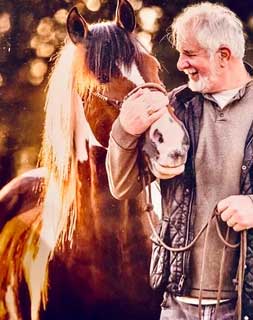
About Tom Equels
Thomas Kenwood Equels, MS, JD, was knighted in the Equestrian Order of Saint Gregory the Great by Pope Benedict in 2012. For decades he has bred and trained winning Thoroughbred racehorses and champion Paso Fino horses on his farm in Ocala, Florida. He has ridden Paso Finos born on his farm to numerous championships including an International Grand Championship at the prestigious USEF sanctioned Spectrum International. A combat-wounded Vietnam veteran, combat pilot and instructor pilot, Equels was twice awarded the Distinguished Flying Cross (DFC) for heroism while participating in aerial combat, as well as the Purple Heart. He is a black belt in karate and was named one of the Florida Black Belt Association’s “Four Season Tour” champions, as well as a National Sport Karate Association (NASKA) National Champion.
As a lawyer, Equels received numerous federal and state awards for his high-impact pro bono work in civil rights, poverty law, and social justice cases. For over three decades he represented foreign states on an international basis, as well as the State of Florida. He also served private companies in the banking, insurance, aviation, pharmaceutical, and construction industries. Since 2016, Equels has served as CEO of Aim Immunotech Inc, an immunology research company focused on the development of therapeutics to treat cancers, immune disorders, and viral diseases.
The Horseman’s Tale
BUY NOW on Amazon
Paperback | Kindle
This excerpt from The Horseman’s Tale is reprinted with permission from Trafalgar Square Books. Visit them online at Horse & Rider Books. All photos courtesy of Horse & Rider Books.
There a more really interesting books on riding and all aspects of equestrian living in our section on Books.
- Minimally Invasive Surgery in the Abdomen - Cornell Equine Seminar
- Get to know...Mette Moe Mannseth, Master Trainer (11:26) - Horses of Iceland
- Autumnal Horse Care: Six Considerations
- Uncovering Secrets | Seen Through Horses Campaign (2:56)
- We love the American Quarter Horse! Why is it such a popular breed?
- The Power of Horses | Breaking Barriers (5:26)
- Rood & Riddle Stallside Podcast - Leading the Way: Dr Katie Garrett on the Impact of the American Association of Equine Practitioners (28:42)
- Monty Roberts Equus Online University - Ace used to bite and intimidate people (2:20)
- Painful Horse Hoof - Satisfying Therapeutic Horseshoeing
- "Finding Her Voice" Story of Transformation | Seen Through Horses Campaign (3:02)
- Haynet Research in Horses: Something to Chew On
- Which Off-Track Thoroughbreds Are Most Desirable?
- Marguerite Henry and the Movies - book excerpt "Dear Readers and Riders: The Beloved Books, Faithful Fans, and Hidden Private Life of Marguerite Henry"
- Danger Zones with Julie Goodnight and Christy Landwehr
- 32 and You: An Owner's Guide to Genetic Tests in Horses (55:02) - Cornell Equine Seminar
- Poor Horse Behavior? It Could Be Pain Related
- The Power of Horses | Supporting Mental Health in Rural Communities (7:58)
- Tackling Thrush in Horses
- Addressing the Shortage of Equine Veterinarians: Nationwide Practices Join Together
- Rood & Riddle Stallside Podcast - Breaking Ground in Laminitis Research with Dr Andrew van Eps (38:13)