




Health & Education
We all want the best care possible for our horses. The Heath & Education section covers both Learning Institutions, Organizations as well as many sources for equine assistance including Veterinarians and Farriers.
For those who want a to formally study horses, the Education section includes College Riding, Equine Studies, and Veterinary Schools. Learn about the wide variety of horses in the Horse Breeds section. Supplements and Treatments Therapy are also included in the section.
Everyone can learn from Fine Art and there are some specialty Museums that might surprise you.
Horses as a therapy partner enrich the lives of the disabled. These facilities are listed in our Therapeutic Riding section. To help children and young adults build confidence and grow emotionally, please see the resources available on the Youth Outreach page.
Looking for a place to keep your horse? You can find it in the Horse Boarding section. Traveling? Find a Shipping company or Horse Sitting service if your horse is staying home!
Want to stay up to date with the latest training clinics or professional conferences? Take a look at our Calendar of Events for Health & Education for the dates and locations of upcoming events.
Do we need to add more? Please use the useful feedback link and let us know!
by Eleanor Kellon, VMD
Both owners and professionals seem to fall into two groups, those who espouse forage only (hay, pasture) and those who focus on the commercial grain they feed. Both are wrong.
FOUNDATION OF EVERY HORSE'S DIET
It's true that the foundation of every horse's diet should be forage. The more work the horse does, the more calories they need and horses doing very physically demanding work often cannot get all the carbohydrates they need to maintain muscle glucose stores (glycogen) with forage alone. That is where concentrated carbohydrate sources come in. However, no horse needs grain for anything else.
WHAT IS HAY
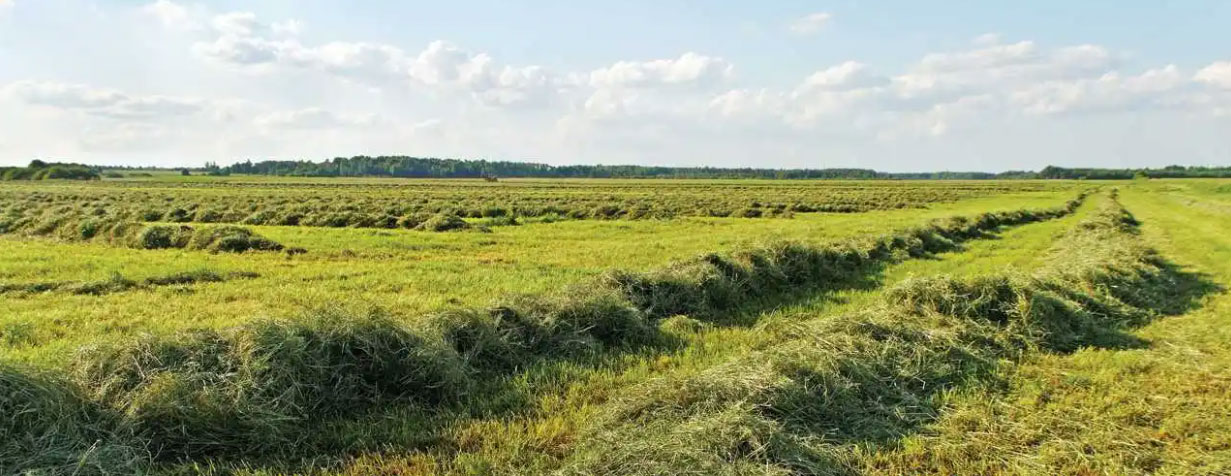
Hay is simply dried grass. It has lower calories and lower carbohydrates than live grass because it continues to metabolize those until water reaches a critical low level and stops enzyme activity.
HAY'S PROTEIN
Hay is the horse's major source of protein. Good quality grass hay contains 8 to 12% protein yielding 362 to 545 grams of protein in 10 pounds. In contrast, 5 lbs of a 10% protein grain has 227 grams. Forage is the major source of protein.
HAY'S VITAMINS
When hay is cured, it rapidly loses vitamins C, E and, over time, the vitamin A precursor carotene. However, it is an excellent source of vitamin D and all the B vitamins are preserved in their biologically activated form.
HAY'S FAT
There is no dietary requirement for fat other than the essential fatty acids which the body cannot manufacture. This hasn't been studied in horses but in other species, alpha-linoleic and linolenic acid, omega-6, and omega-3. Live grass is a rich supply of both but cured hay loses its omega-3 and this needs to be replaced with flax or Chia seed. Grains and all the common vegetable oils are low in omega-3 and high in omega-6.
HAY'S ESSENTIAL MINERALS
Hay or grass contains all the nutritionally essential minerals, although not necessarily in the correct minimum amounts or ratios. Grains are not inherently balanced either but manufacturers can add what is needed to help meet minimum levels. What they cannot do is correct imbalances in the hay and for most horses that leaves the bulk of the diet unbalanced.
HAY ANALYSIS
Hay analysis is the ideal way to find out what needs to be added to the diet to balance hay. You can also reach out to your local agricultural extension agent or the state agriculture department to get average figures for where the hay was grown.
CONCLUSION
If horses were still roaming over hundreds of miles eating a wide variety of vegetation we wouldn't have to consider the imbalances created by the exact same diet for months or even years. It takes a little effort to get the diet maximized but well worth the effort.
This article originally appeared on Uckele Nutrition and is published here with permission.
There are lots of good articles in our section on Health & Education.
Certified Horsemanship Association Instructor Dale Rudin explains reading horse behavior and how the horse communicates through body language in this educational tip by Certified Horsemanship Association
- Why Do Horse Breeders Terminate a Twin?
- Rood & Riddle Stallside Podcast: The Importance of Ultrasound with Dr Colton Thacker (26:33)
- Infection Disease Control tips for Horse Farms - Dr. Scott Weese (15:62)
- Why the Sudden Behavior Change in My Horse?
- Hydrolyzable Carbohydrates and the Metabolic Horse
- Rood & Riddle Stallside Podcast - 0:03 / 27:14 • Intro The Most Interesting Guest so Far with Dr Bart Barber - Episode 50!
- Catching the Horse in a Paddock with Teresa Kackert (5:29)
- Equine Guelph Declares February Colic Prevention Education Month
- The History Of Equine Slaughter In The United States (Part 2 In A Series)
- Rood & Riddle Stallside Podcast - The PET Scan, Old Technology, New Applications with Dr Katie Garrett and Dr Jose Bras (33:01)
- To Shoe or Not to Shoe? An Excerpt from Shoeing the Modern Horse
- Rood & Riddle Stallside Podcast - The Time is Right for Your Barren Mare’s Check up with Dr Pete Sheerin (37:37)
- Ten Tips for Lunging Your Horse
- 5 Tips to Help You Train Your Horse
- Stem Cells Under Investigation as a Possible Future Treatment for Equine Asthma
- Fitness for the Pregnant Rider - an excerpt from "Ultimate Exercise Routines for Riders"
- Published: Canagliflozin for Control of Refractory Equine Hyperinsulinemia and Laminitis
- Building Your Horse’s Confidence
- Help Nix the Culex Mosquito that Transmits 3 of 5 Core Equine Diseases
- Communication Between Human and Horse