




Health & Education
We all want the best care possible for our horses. The Heath & Education section covers both Learning Institutions, Organizations as well as many sources for equine assistance including Veterinarians and Farriers.
For those who want a to formally study horses, the Education section includes College Riding, Equine Studies, and Veterinary Schools. Learn about the wide variety of horses in the Horse Breeds section. Supplements and Treatments Therapy are also included in the section.
Everyone can learn from Fine Art and there are some specialty Museums that might surprise you.
Horses as a therapy partner enrich the lives of the disabled. These facilities are listed in our Therapeutic Riding section. To help children and young adults build confidence and grow emotionally, please see the resources available on the Youth Outreach page.
Looking for a place to keep your horse? You can find it in the Horse Boarding section. Traveling? Find a Shipping company or Horse Sitting service if your horse is staying home!
Want to stay up to date with the latest training clinics or professional conferences? Take a look at our Calendar of Events for Health & Education for the dates and locations of upcoming events.
Do we need to add more? Please use the useful feedback link and let us know!
By Juliet M. Getty, Ph.D.
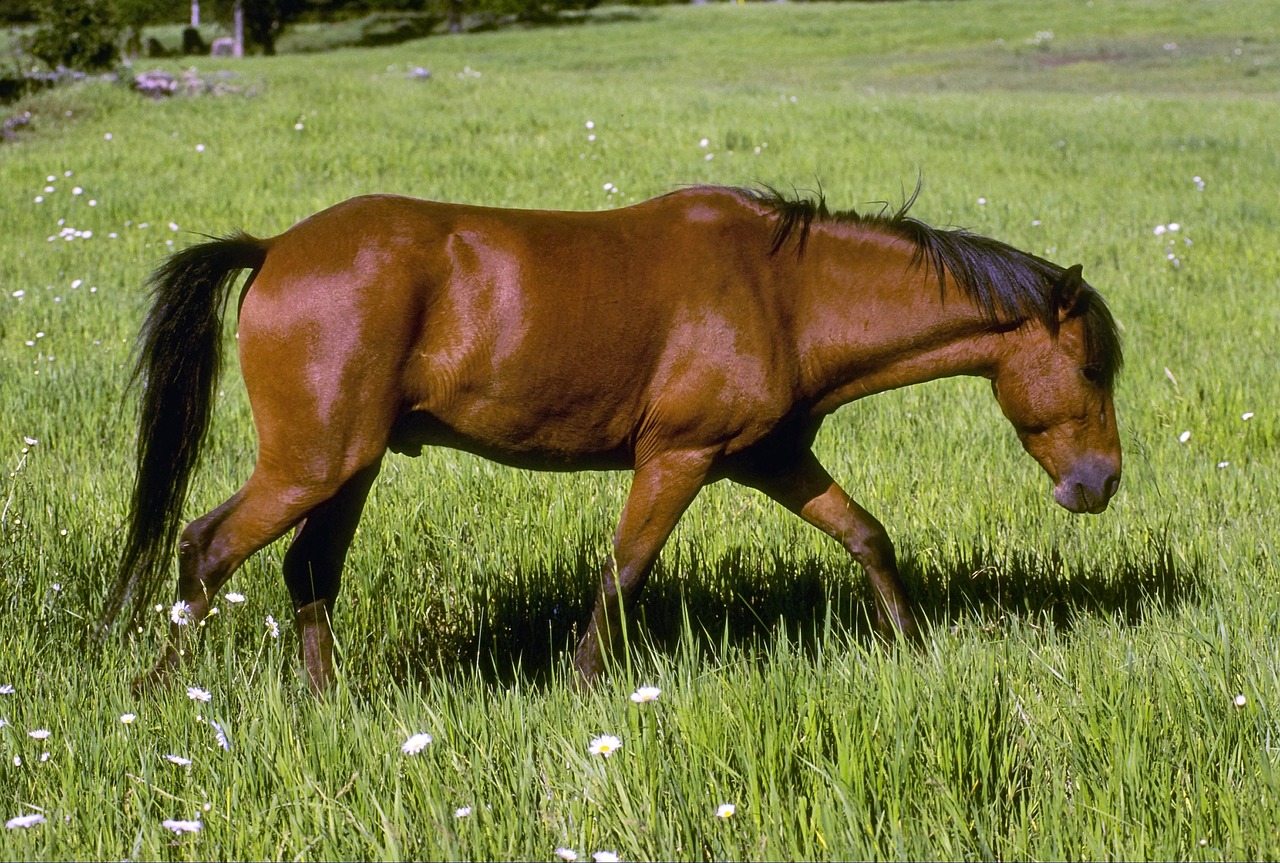
A smooth, strong topline is a definitive sign of health. Your horse’s back musculature not only looks good but is important for his ability to support his spine and joints.
If the topline is diminished, it is important to assess its cause. Some possible reasons include:
- Multiple pregnancies
- Poor saddle fit
- Ridden at too early an age
- Lameness
- Too much time in a stall – not enough movement
- Weakened abdominal muscles
- Muscle-related diseases such a polysaccharide storage myopathy (PSSM) and exertional rhabdomyolysis (ER)
- Pituitary pars intermedia dysfunction (PPID), commonly called Cushing’s disease
- Weight loss diets that restrict forage
- Aging
- Low quality nutrition
While each of the above points can be discussed at length, emphasis will be on the last four bullet points since they are influenced by your horse’s diet.
Why does PPID cause muscle loss?
One of the first physical characteristics of this disease is a decline in topline muscle mass.[i] Cortisol is a catabolic hormone, meaning it causes muscle weakness and wasting. Because of the excessive production of adrenocorticotropic hormone (ACTH), and hence, cortisol, the muscles will break down or atrophy, and so you will see a characteristic swaying of the back.
Losing weight by limited forage intake will make matters worse[ii]
Reducing caloric intake and burning more calories helps your horse’s body use the energy he is storing. But there is a component to weight loss that has nothing to do with calories – it has to do with hormones. Hormones, such as cortisol and insulin, dictate to your horse’s body how much fat he will store; these hormones are keenly sensitive to stress.
If you are seeking help for your overweight horse, you may be getting advice that is unsuitable for your horse’s long-term health. If eating less means taking away hay or pasture, then it is contradictory to what your horse needs. Yes, do take away fattening cereal grains and sugars, but never, never, never restrict forage.[iii] Why? Because restricting forage is the most stressful thing you can do to your horse.[iv]
Restricting forage results in loss of muscle mass.[v] You will see weight loss, but much of it is due to a reduction in the longissimus dorsi muscle that runs along the topline.[vi]
Aging[vii]
The body changes with age, along with reduced muscle mass[viii] for several possible reasons:
- Saliva and digestive enzyme production diminish. This can result in poorly digested feed. Combined with possible poor dentition, and your horse may not be getting the calories and nutrients he requires.
- Stressors can impact the hindgut microbiome. Stress due to bodily aches and pains, and possible changes in pecking order within a herd can influence the microbiome’s health and ability to digest fiber for calories.
- Insulin resistance. Many horses develop metabolic conditions with age that manifest themselves as insulin resistance. In this situation, the tissues do not get enough glucose, leading them to rely on muscle for glucose production.
- Reluctance to move. Loss of muscle tone is inevitable if the horse is retired and no longer has the same level of physical activity. Degenerative joint conditions can also make your horse less eager to exercise.
How many pounds of protein does a horse require?
On average, an adult horse at maintenance will benefit from 1.4 lbs (636 grams) of protein per day.[ix] Horses who exercise moderately require more (2 to 2.15 lbs per day; 908 to 976 grams per day). To put this into perspective, consider your horse consuming 20 lbs of hay with 10% crude protein content - providing 2 lbs of protein per day. This would appear to be sufficient, but the “quality factor” needs to be considered.
Forage protein quality
If your horse gets only one variety of forage, whether fresh pasture grasses, or hay, the protein quality will be low. Adding alfalfa or mixed grasses will definitely improve the protein profile. The more forage variety, the better.
Crude protein is not a measure of quality.[x] It merely tells you how much nitrogen is in the feed. To be of high quality, there needs to be sufficient essential amino acids in the proper proportion so the horse can produce proteins throughout the body.
What protein sources can you consider for topline improvement?
By adding other sources of protein, the amino acids from forages can be better utilized and fewer of them will go to waste.[xi] Some good examples:
SEEDS
- Hemp seed meal- 22 grams of protein in 1/2 cup. Hemp seed meal is high in excellent quality protein (33%) and lower in fat than the hearts (10%).[xii]
- Hemp seed hearts - 29 grams of protein in 1/2 cup. Hemp seed hearts are even more concentrated in protein, and their quality is the best source of plant protein.[xiii] Highly palatable.
- Chia seeds- 9 grams of protein in 1/4 cup. Chia seeds are excellent to include in all horses’ diets because of their protein content, but more importantly, because of their perfectly proportioned essential fatty acid content.[xiv]
- Flax seeds (ground)- 10 grams of protein in 1/2 cup. Like chia, with an essential fatty acid proportion that mimics the omega 3 to omega 6 ratio found in fresh pasture grasses.[xv]
- Pumpkin seeds – shell removed- 37 grams of protein in 1/2 cup. Highly concentrated source of protein and digestive enzymes. The fat content is mainly omega 6 -linoleic acid (LA) which can be inflammatory if omega 3s are not also added to the diet.
- Black oil sunflower seeds with the shell- 5 grams of protein in 1/2 cup. Mostly fiber. High LA content makes them inflammatory if omega 3s are not also added to the diet.
LEGUMES
- Soybean meal- 27 grams of protein in 1/2 cup. GMO Soy is not advisable.[xvi],[xvii],[xviii],[xix] Organic soy is excellent in quality.
- Split peas- 24 grams of protein in 1/2 cup. Can add water to soften but horses enjoy crunchy texture. High in lysine.
- Pea protein isolate- 30 grams of protein in 1/2 cup. More concentrated in protein that the split peas.
- Lupins- 25 grams of protein in 1/2 cup. Similar to peas, they are often added to horse feed, especially in Australia.
ANIMAL PRODUCTS
- Whey protein isolate- 40 grams of protein in 1/2 cup. High quality protein from milk. Whey concentrate can contain lactose; therefore, choose the isolate.
- Colostrum- 18 grams of protein in 1/4 cup. This is an excellent superfood.[xx] It provides insulin-like growth factors (IGF) which promote optimum muscle growth during exercise.[xxi] Also beneficial for aging horses who may be becoming more frail.
- Collagen- 28 grams of protein in 1/4 cup. Contributes to joint and muscle strength.
OTHER
- Copra meal- 22 grams of protein in 1/2 cup. This is coconut meal. Its protein is not high in quality[xxii] with a relatively poor level of lysine and other essential amino acids. When mixed with other protein sources, it helps boost the overall amino acid profile. Contains coconut oil, which is devoid of essential fatty acids.[xxiii]
Other nutrients for muscle mass development
Spirulina. This is a type of blue-green algae. It has been touted as a good food for muscle building, but it is relatively low in lysine and methionine. But when added to the diet that contains other sources of proteins, it can contribute to a healthy amino acid pool. Its main benefit is for immune support, particularly insect-related allergies.
Amino acid supplements. Many preparations offer three of more of the 10 essential amino acids, typically lysine, methionine, and threonine, since these three have been studied the most. The branched chain amino acids -- leucine, isoleucine, and valine, are essential amino acids that are found in high concentrations within muscle cells.
Vitamin B6. Pyridoxine (vitamin B6) is required for protein synthesis. Since the microbial population in the hindgut can produce this vitamin, its supplementation is generally not necessary. However, an aging or stressed horse may experience a decline in B vitamins. B6 in particular, increases the gene expression of factors that promote the growth and repair of skeletal muscle.[xxiv] Supplementing B6 to horses hasn’t been studied extensively but providing 30 to 70 mg per day may be beneficial in the short term.[xxv]
Gamma oryzanol. A plant sterol that has an anabolic (building) effect on muscle mass. Found in low concentration in rice bran oil, it is better to choose an extract. It stimulates muscle development in exercised horses.[xxvi] It is not beneficial however, for sedentary animals.
Bottom line
The horse relies on a diet that is sufficient in quality protein to maintain a healthy, strong topline. By feeding several protein sources, you can provide your horse’s body with an ample essential amino acid pool from which body proteins can be produced. Since pasture grasses and hays often do not provide enough amino acid variety, it is worth adding high-protein whole foods to boost the overall value of the diet.
This article originally appeared on Getty Equine Nutrition and is published here with permission.
Find more informative articles in our section on Health & Education.
Monty Roberts shares horse training ideas for horse lovers who want to educate themselves on the behavior and needs of horses. Find out more at montyroberts.com
Read more: Ask Monty: Why is my horse aggressive at feeding time? (1:22)
- New Tool Recognizes Pain in Horses with Osteoarthritis
- My Horse is Gaining Weight on Free-Choice Forage! Why Isn't it Working?
- 6 Must-haves For Your Next Horse Show
- Inside the Recipient Mare Herd from the Rood & Riddle Reproduction Center with Crystal Howard" (24:28)
- Breeding for the Next Champion: 6 Important Considerations for Broodmares
- Empty Fields Everywhere Why Movement is So Important
- Hard Tying the Horse to a Rail or Post with Michal Kays (5:37) - Certified Horsemanship Association
- The Icelandic Horse - Quite the Characters!
- 4 Signs of a Happy Horse
- Stallside Podcast - Behind the scenes with the Rood & Riddle Anesthesia and Surgery Technician Team (34:01)
- Breaking the Cycle of Hoof Lameness: Navicular, Laminitis, Pedal Osteitis (14:25)
- Rood & Riddle: Advances in Equine Healthcare (6:37)
- Extending Photoperiod for Muscle Development in Young Horses
- Adopting a Wild or Feral Mustang?
- Rood & Riddle Stallside "Inside the Breeding Shed with Sandy Hatfield, Stallion Manager at Three Chimneys Farm" (31:37)
- The Horses of Iceland - Many Different Colors
- Minis – A Big Horse in a Little Package
- Holding the Horse for the Vet or Farrier with Julie Goodnight (7:03)
- Fitting the Martigale with Julie Goodnight (12:33)
- Colic in Horses, Explained