




Health & Education
We all want the best care possible for our horses. The Heath & Education section covers both Learning Institutions, Organizations as well as many sources for equine assistance including Veterinarians and Farriers.
For those who want a to formally study horses, the Education section includes College Riding, Equine Studies, and Veterinary Schools. Learn about the wide variety of horses in the Horse Breeds section. Supplements and Treatments Therapy are also included in the section.
Everyone can learn from Fine Art and there are some specialty Museums that might surprise you.
Horses as a therapy partner enrich the lives of the disabled. These facilities are listed in our Therapeutic Riding section. To help children and young adults build confidence and grow emotionally, please see the resources available on the Youth Outreach page.
Looking for a place to keep your horse? You can find it in the Horse Boarding section. Traveling? Find a Shipping company or Horse Sitting service if your horse is staying home!
Want to stay up to date with the latest training clinics or professional conferences? Take a look at our Calendar of Events for Health & Education for the dates and locations of upcoming events.
Do we need to add more? Please use the useful feedback link and let us know!
By Juliet M. Getty, Ph.D.
If we were to visit about your horse’s health, the first thing I would ask of you is to describe your horse’s typical day. I’d want to know how much space he has, if he’s locked inside a stall all day, it he gets exercise, if he has a buddy, if he has freedom to run and buck and express himself. And I haven’t even asked a word about what he is eating!
Certainly, we need to talk about things like too much sugar, or not enough protein, or vitamins that are missing in his diet. But not just yet…
We must first address an aspect of his health that is so simple; it seems so trivial and unimportant, and hardly ever talked about. His DIGESTIVE TRACT. That’s what makes him happy! Why? Because if we don’t pay attention to this area, he will be in pain – it’s hard to smile when you’re in pain.
If we don’t pay attention to what is living in his cecum and colon (hindgut), he will get ill easier, and it’s hard to buck and run when you’re sick. And, you may not be aware of this, but the intestines produce neurotransmitters like serotonin and dopamine, the feel-good chemicals. Sick intestines? Unhappy horse.
To have a horse who enjoys life, you must pay attention to both his brain, and his digestive system. They are intertwined. Here are five important considerations to make this happen.
Offer companionship
Horses are never alone by choice. The protection of another herd member is a means of survival against threats, real or perceived. Without a companion, your horse may not sleep sufficiently.
Yes, horses do nap standing up, but they require at least 20 minutes per day lying completely prone. Even a herd of two is fine; one horse is allowed to take a deep nap, while another watches over for predators. This is how horses survive. Sleep deprivation is a real threat to horses who are alone, and it can lead to many physical ailments.
Provide room to roam
Horses are naturally claustrophobic and when kept in a confined space, can feel anxious and fearful. When faced with a threat, horses do not stick around and fight; instead, they flee!
Without an opportunity to do so, they internalize their fate and can develop negative behaviors and habits, and well as suppressed immune function. They frequently become mentally depressed, as well.
I realize that many horses need to be kept indoors for a variety of reasons. I know you love your horse, and I ask that you provide opportunities for him/her to be outdoors, with breaks in the day to graze, walk, and merely enjoy the fresh air as much as is feasible. Your horse will thank you.
Movement is critically important to prevent several health problems[1]. We all know the benefits of exercise, including weight management, increased bone mass, improved circulation of nutrients, and keeping the horse fit. But standing in one place can impact your horse’s mental well-being, potentially leading to unattractive and even dangerous behaviors.
Remove pain from the equation
Pain is miserable. One of the most common reasons for pain in unhappy horses is ulcers. The reason this is so prevalent has to do with the horse’s stomach physiology.[2] Your horse’s stomach secretes acid every minute of every day, even when empty.
A horse who goes for more than two to three hours with nothing to chew on will more than likely develop an ulcer somewhere throughout the gastrointestinal tract.
Interestingly, a horse who is accustomed to living freely, and is suddenly placed in a stall, will develop a gastric ulcer within a week. This can happen, for example, when a horse is sent off to a facility for training. In my experience, these horses come back home in very poor condition, and it takes a lot of effort to get them back to health.
Ulcers are preventable. End of story. And not by giving a horse omeprazole like it is candy. The horse’s digestive tract is designed to have forage always flowing through it! Do we respect that?
We are so afraid of our horses becoming overweight that we destroy their insides. Know this undeniable truth: Forage restriction is highly stressful. Stress = Cortisol production = Increase in Insulin = Body fat storage. I have written numerous articles on the subject that I hope you’ll take to heart.[3]
As a side note, you may want to evaluate your horse for potential ulcers by watching a video by Dr. Mark DePaolo on palpating acupuncture points.[4]
Pain from other sources can often be managed through providing nutraceuticals, instead of drugs.[5] Anti-inflammatory agents such as curcumin and Boswellia, and CBD[6] are worth trying. Avoid inflammatory foods such as soy (unless it is organic), soybean, corn and other vegetable oils (high in inflammatory omega 6s) and feeds high in preservatives.
Respect the horse’s instincts
When we see images of wild horses running free, we all experience the hush, the chill, and the awe of their power and magnificence. That is Nature at her best – allowing these incredible animals to live as they are intended. Why is it that we don’t see our own domesticated horses in the same way?
Why is it that we think we can confine them to a small area for hours at a time, give them a few “square meals” each day and expect them to be normal, physically, and mentally? Are they not the same horse species that long ago lived a different life?
Interestingly, we don’t see endocrine-related laminitis when horses are wild and free to feed themselves.
But we do see insulin resistance, and that’s a blessing in the wild. Insulin resistance is the body’s way of avoiding starvation. During a harsh winter, when the food supply is sparse, horses will hold on to body fat to help them endure the season. They do this by having an elevated blood insulin level. When insulin is high, the cells cannot release fat.
This is a survival mechanism. We duplicate this scenario when we restrict forage. The horse responds the same way – he is in survival mode! And he holds on to body fat.
It takes time, sometimes lots of it, to overcome this “winter is coming” mentality that is created when hay is removed. It requires patience for their instincts to return. Know that it can happen.[7]
Offer whole foods to the diet
A whole food is one that is unadulterated or in its natural state; in other words, it has nothing added. There are no preservatives or fillers, so it’s whole in the sense that it is in the state nature intended. And with that comes all sorts of vitamins, proteins, and micronutrients.
Pasture grasses are the ultimate whole food. During growing seasons, they are rich in omega 3 fatty acids, vitamins C, D, and E, beta carotene, and prebiotics. Once cut, dried, and stored to make hay, however, the once healthy grasses now lose these precious nutrients, and supplementation is necessary.
If your horse’s main, or only source of forage is hay, then listen up! Hay is lousy nutritionally. Yes, it has some minerals, and some protein (though not of high quality), but your horse will develop nutritional deficiencies over time, age faster, and experience more degenerative conditions.
Whole foods are feedstuffs that you can offer to your horse to boost his overall health. Things like ground flaxseeds, chia seeds, and camelina oil (for omega 3s), hemp seeds (for protein quality), green bananas (for digestive and behavioral health), herbs (for digestive and immune health), colostrum (for leaky gut and inflammation)[8], as well as additional forages such as clean, organic alfalfa, sainfoin, and non-GMO beet pulp[9], can make your horse vibrantly healthy and happy.
Bottom line
The horse’s mind and the body are connected in such a way that what influences one has a dramatic impact on the other. Horses are very different than us, our pets, or even farm livestock, and those differences need to be honored. When we allow our equine friends to live in sync with their instincts and physiology, only then are we able to view their beautiful potential and majesty.
This article originally appeared on Getty Equine Nutrition and is published here with permission.
Find more informative articles in our section on Health & Education. While you're here, take a look at our Curated Amazon Store.
by Kentucky Equine Research Staff
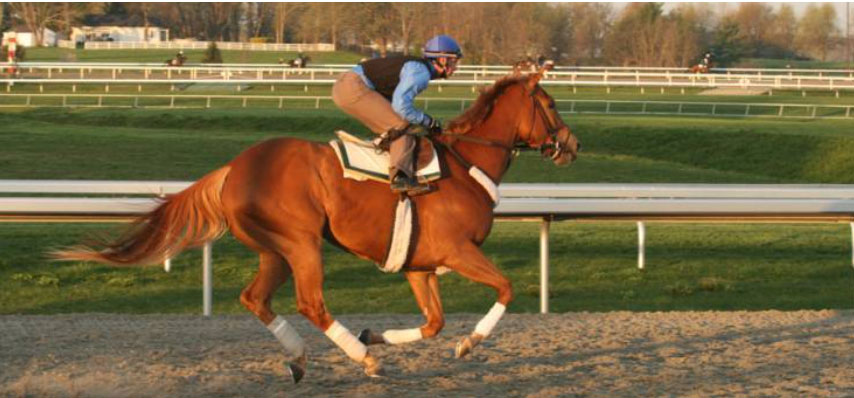
In addition to the host of intangibles involved in training horses, adding science to the mix may help improve a racehorse’s chance of success. According to a group of European researchers, measuring stride length and frequency—how far horses stretch their limbs and how fast they move their legs—during training could assist in race length selection.*
To explore whether stride characteristics could help classify racehorses as sprinters or stayers, a wearable smart device was commissioned. The device recorded peak stride length and frequency as well as speed in a large cohort of racehorses during training sessions.
“In those race-speed training sessions, locomotory differences were detected, with sprinters having shorter strides of higher frequency than stayers,” explained Catherine Whitehouse, M.S., of Kentucky Equine Research.
In addition, peak stride length was found to be moderately heritable after reviewing three generations of pedigrees from included horses.
“A better understanding of individual stride characteristics could help racehorse professionals select suitable race distances, while also taking into account their own experience at placing racehorses in suitable meetings alongside other historical aspects of how racehorse conformation and pedigree information can influence such decisions,” according to the research team.
“In other words, not only will identifying whether a horse is more suited to shorter or longer races improve their chances of winning but also allow trainers to develop more specific training sessions,” Whitehouse noted. “Targeted training that considers speed, stride frequency and length, and biomarkers of fatigue may, in turn, promote longer careers and improve welfare on the track.”
Regardless of a Thoroughbred’s individual stride characteristics, all racehorses must withstand joint concussion during training and racing.
“Offer Synovate HA to keep those joints lubricated for friction-free movement and to maintain a healthy balance between cartilage growth and breakdown,” advised Whitehouse.
Synovate HA is a high molecular weight hyaluronic acid supplement that provides 100 mg per serving for targeted support to high-motion joints.
“A Kentucky Equine Research study showed horses supplemented with Synovate HA maintained their stride length during a high-speed treadmill training program compared to the control group,” she added.
*Schrurs, C., S. Blott, G. Dubois, E. Van Erck-Westergren, and D.S. Gardner. 2022. Locomotory profiles in Thoroughbreds: peak stride length and frequency in training and association with race outcomes. Animals (Basel) 12(23):3269.
Reprinted courtesy of Kentucky Equine Research. Kentucky Equine Research is an international equine nutrition, research, and consultation company serving horse owners and the feed industry. Our goals are to advance the industry's knowledge of equine nutrition and exercise physiology, apply that knowledge to produce healthier, more athletic horses, and support the nutritional care of all horses throughout their lives. Learn more at Kentucky Equine Research.
There a more informative articles in our section on Health & Education. While you're here be sure to visit our Curated Amazon Store.
- Five Things About Joint Care
- The Efficacy of Sponge Baths and Hosing on Exercise Recovery in Thoroughbred Horses
- Smarter Grazing: How Satellite Technology Supports Sustainable Horse Pasture Management
- Managing Energy and Motivation While Caring for Your Horses
- Five Tips for Hiring a Horse Shipper
- Tall Fescue Toxicity in Mares
- Healthy Joints for Years of Happy Trails
- $20,000 in student scholarships offered by Purina Animal Nutrition
- Saddle Fit Differences Between Men and Women
- Use of Standardized Exercise Tests in Equine Research
- Helping all horses live healthier lives
- 5 Tips For Keeping Aged Horses Fit To Compete
- Fruits are Fabulous, even for Insulin Resistant Horses!
- 12 Tips for Being a Good Member of Your Boarding Barn - an excerpt from "Newcomer to the Horse World"
- $10,000 Equestrian Merit Scholarship
- Non-GMO is NOT Necessarily Safe
- Consider Beet Pulp Instead of Oats
- Five Tips About Dummy Foals
- The Role of Nutrition in Managing Muscle Disorders
- Secrets of Successful Riding Instructors