














You like our Facebook page and we like yours. You follow us on Twitter and Instagram and we follow you. You subscribe to our You Tube Channel and we subscribe to yours.
You publish the EIE logo and link on your website and we list your business on EIE in the category of your choice.
Grow you Social Media presence and reach our audience! We've got a monthly social media reach of over 4,000,000 who are horse people of all kinds, from business owners to trainers to riders.


Dave Dellin, the Director of Judges for the American Paint Horse Association, gives educational tips on the fundamentals of showmanship.
For more information on the largest certifying body of riding instructors and barn managers in North America, Certified Horsemanship Association, please visit www.CHA.horse. To find a certified equine professional or accredited equine facility near you, visit www.CHA.horse.
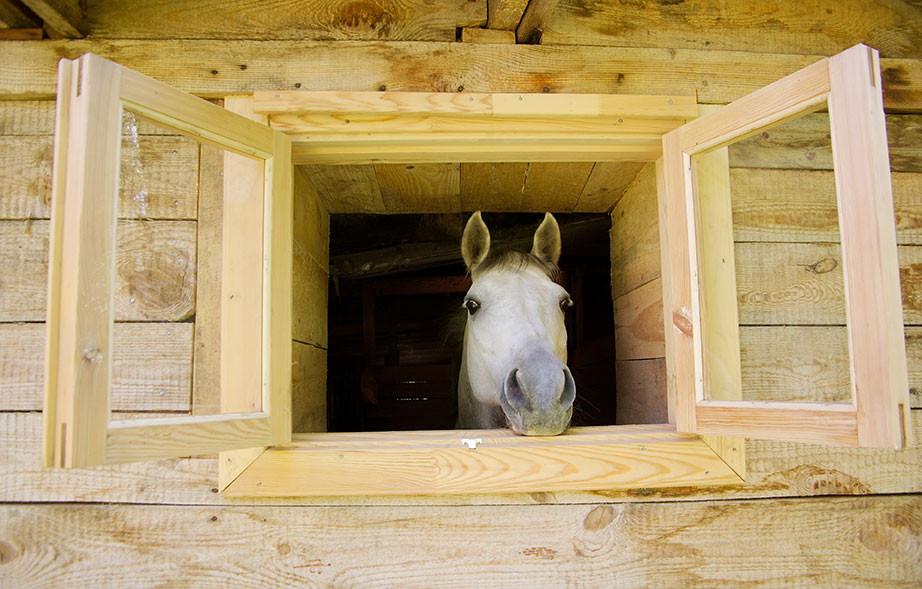
As horse owners who aren’t able to keep horses on their own property, we’ve all had to find a place for a new horse or move a horse from their current barn to another. Here’s a checklist of things to keep in mind when finding a new barn for your horse.
We launched a new service in our Horse Boarding section! You can easily find any horse boarding location on a clickable map with links to all the information you need. Find your barn then check it out!
Does this list look important to you? You can print it out to take it with you when you visit a potential barn. Or, just download it to view it for your phone whether you're connected to the internet or not.
Download this Checklist HERE.
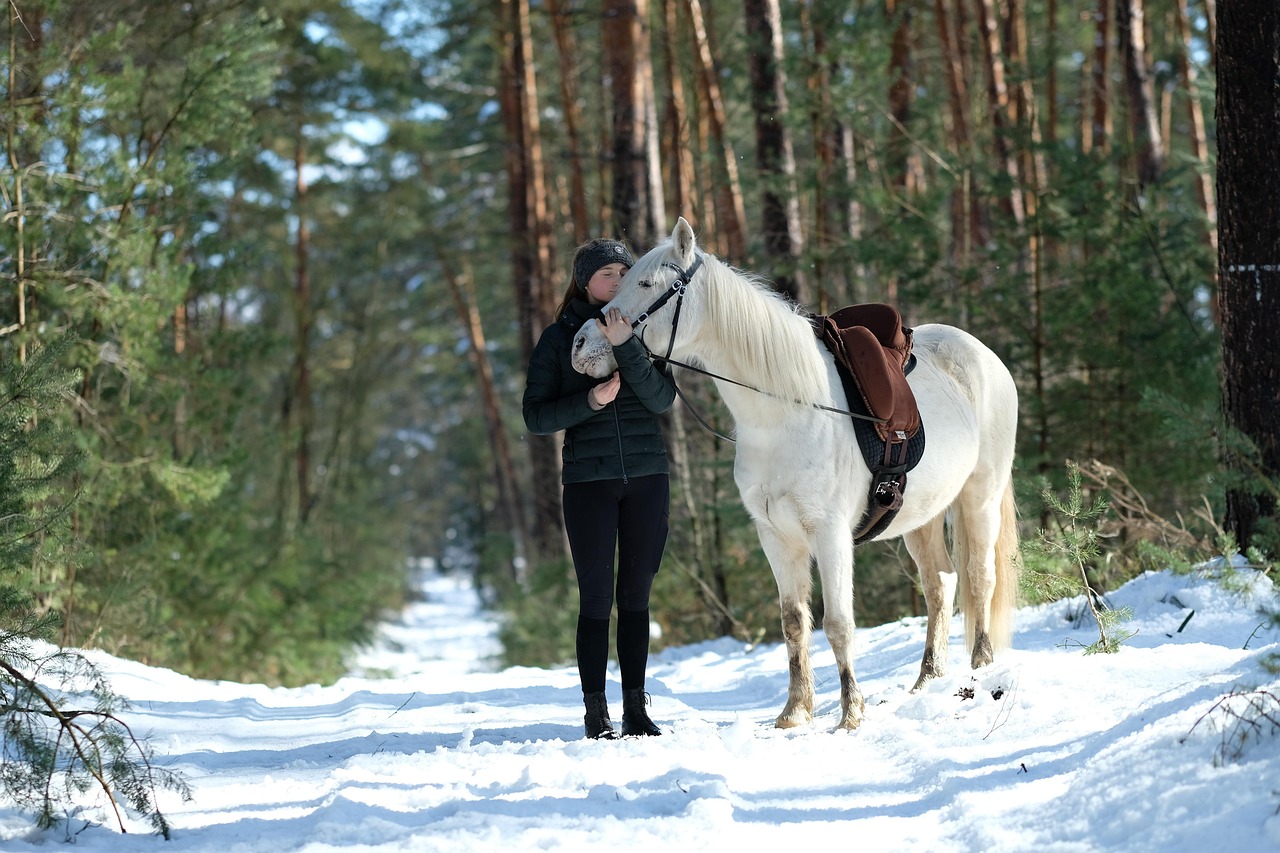
Short days combined with cold weather can trigger seasonal depression, even for the happiest of people. You are not alone! Horse can help fight the winter blues through a combination of physical activity, emotional connection, and engaging, focused activities that provide purpose and social interaction.
Even if outdoor riding is limited, there are many activities you can do:
If you find that the winter blues persist and significantly impact your daily life, it's important to seek professional help. Equine-assisted therapy, facilitated by a mental health professional and an equine specialist, can be a valuable complementary treatment for symptoms of Seasonal Affective Disorder (SAD) or depression.
You can find more informative articles in our section on Recreation & Lifestyle. Take a look at our Curated Amazon Store for our selections in a wide variety of categories!
Are you interested in promoting your business or sharing content on EIE? Contact us at info@equineinfoexchange.com
The Gypsy Vanner, famed for their beauty and adored for their personalities. In this episode travel to America's Gypsy Vanner Foundation Farm as we learn the story of how the breed came to be, meet one of the most viewed Gypsy Vanner Stallions in the world and go for a ride on the incredible black stallion, BB King!
Read more: One Woman's Quest: The Beautiful Gypsy Vanner (5:32)
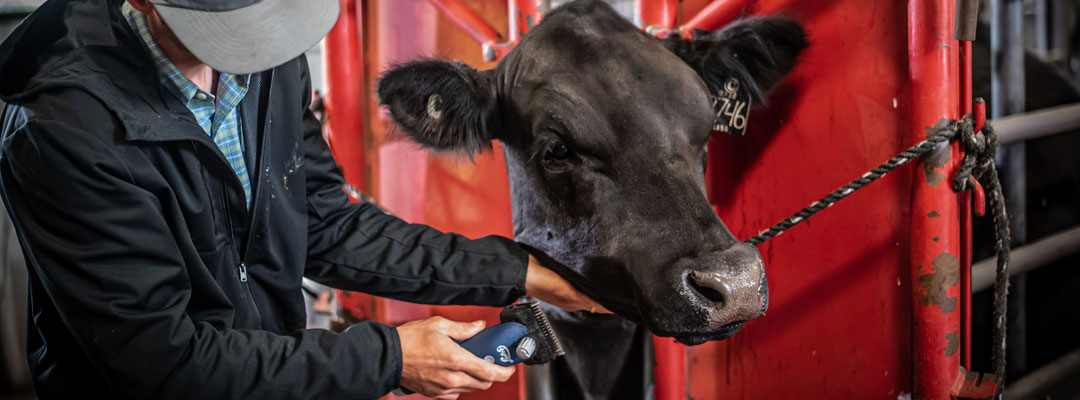
Clipping livestock or equine before a show does not have to be overwhelming. With so many clippers, blades, and styles to choose from, it is easy to get confused. Roxanne Zenner from Andis, breaks down what is needed to choose the right blades, maintain equipment, and clip effectively.
Clipper blades can be found in detachable blades or adjustable blades.
All detachable blades are interchangeable with industry-standard clippers, including brands like Andis, Wahl, Oster, and Heiniger. Blades from different brands can also be used together, allowing flexibility for grooming needs. When changing out blades, turning the clipper on while installing ensures proper alignment. Detachable blades are made from stainless steel or ceramic. With ceramic, blades stay sharper longer, heat up slower, and leave fewer track lines, helping prevent going over the same spot multiple times. Blades are also available in wide or fine-tooth versions.
Adjustable blades, usually found on trimmers, allow manual changes to the cutting length and work best for cleanup rather than full-body clipping.
The numbers on the blades indicate hair length. Lower numbers leave hair longer, while higher numbers cut it shorter.
New to clipping? Start with guards on the blades. Guards provide a forgiving cut, reducing the risk of taking too much hair at once, and help develop a feel for the clippers and blades. Once confident, remove the guards for more precise, controlled strokes.
The choice between corded and cordless clippers often comes down to convenience, budget and preference. Cordless clippers match corded units in power and are ideal for barns or areas without easy access to electricity. Corded clippers provide uninterrupted power, which can be reassuring for longer clipping sessions.
Clippers are available in a range of speeds, from 2,500 - 6,500 strokes per minute, and can feature one-speed, two-speed, or five-speed options depending on the model.
Proper blade maintenance prolongs the life of both the blade and the clipper. Oiling blades after each use is essential to prevent rust and preserve performance. For extended clipping sessions and disinfection, Cool Care Plus can be applied to blades to keep them cool and reduce the risk of spreading viruses.
Blade Care Plus can be sprayed directly on the blade or used to gently immerse and run the blade, rinsing away excess hair and buildup. Store blades properly, protected from the elements, to prevent rust and damage.
Blades should be replaced or sharpened if they leave track lines, snag or fail to cut smoothly. Slow performance or unusual noises may indicate that the Blade Drive or Hinge Assembly, located under the Drive Cap, need replacement.
Before clipping, bathe and brush the animal thoroughly. This reduces stress for the animal, the clipper, and the handler. Introduce the clipper gradually, letting the animal feel the vibrations and hear the noise. Placing the running clipper gently against the animal helps them adjust before full clipping begins.
Understanding clippers, blades, and proper technique ensures a smooth grooming experience and helps animals look their best for any show.
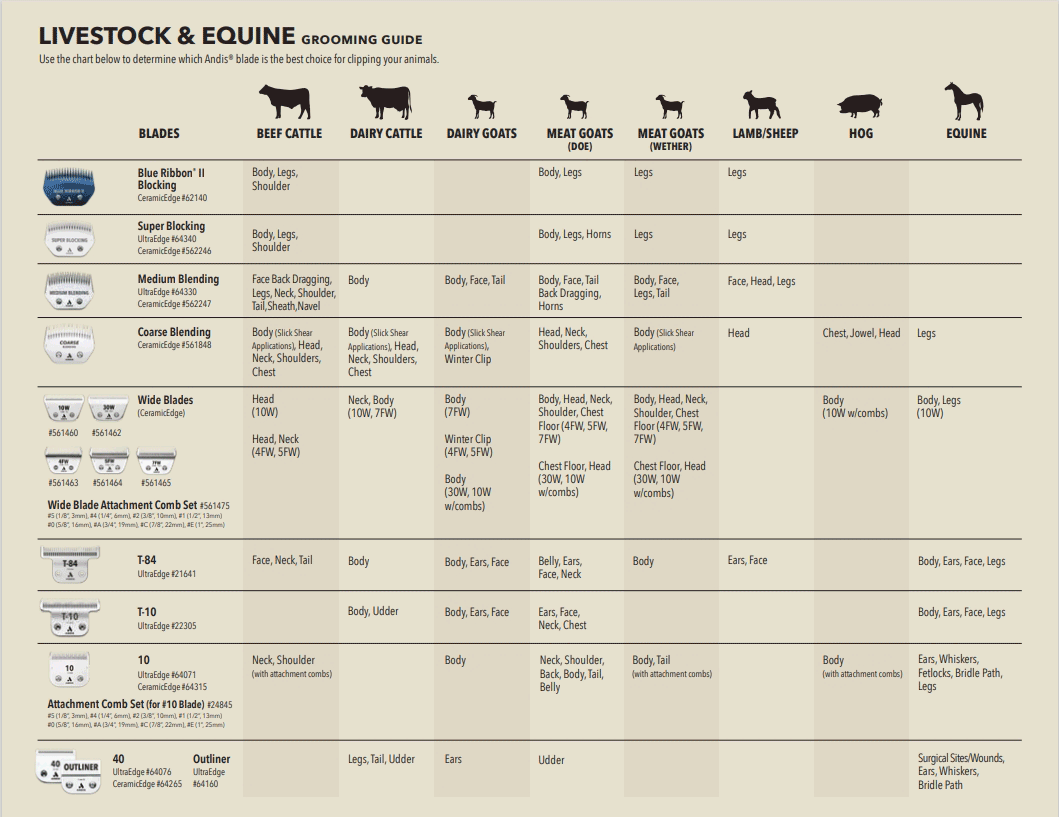
The chart below provides a quick guide to the best blade choices for different areas of the animal. Chart provided by Andis.
Whether for horse, livestock or pet, Valley Vet Supply is your one-stop shop for trusted care. Explore more of our show / grooming supplies category at ValleyVet.com.
All photos courtesy of Valley Vet.
There are more informative articles in our section on Health & Education. While you're here, take a look at our Curated Amazon Store.
Are you interested in promoting your business or sharing content on EIE? Contact us at info@equineinfoexchange.com


Our Mission — Serving the professional horse person, amateur owners, occasional enthusiasts and sporting interests alike, the goal is to serve all disciplines – which often act independently yet have common needs and values.
Equine Info Exchange is totally comprehensive, supplying visitors with a world wide view and repository of information for every aspect related to horses. EIE provides the ability to search breeds, riding disciplines, horse sports, health, vacations, art, lifestyles…and so much more.
EIE strives to achieve as a source for content and education, as well as a transparent venue to share thoughts, ideas, and solutions. This responsibility also includes horse welfare, rescue and retirement, addressing the needs and concerns of all horse lovers around the world. We are proud to be a woman-owned business.